Loading image...

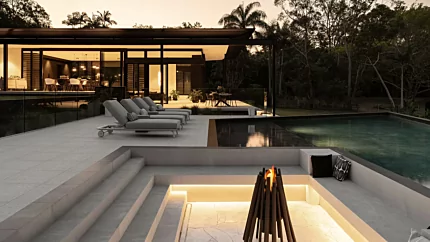
Stix 8 Fire Pit
A fire pit that looks immaculate in a Melbourne showroom can look very different after two summers in Noosa. Salt air, relentless UV and forty-degree heat treat outdoor metalwork harshly, and the same model that ages gracefully in the Adelaide Hills can show tea-staining within months a few streets back from the surf. The difference is rarely build quality. It's the match, or mismatch, between the material and the climate it has to live in. A weather-resistant fire pit is not a product category. It is a location-specific decision, and the smartest way to make it is to start with your postcode rather than the catalogue photo.
Loading image...
Stix 8 Fire Pit
A weather-resistant fire pit is one whose material withstands the specific environmental forces of its location, salt-laden coastal air, intense UV radiation, sustained summer heat and seasonal moisture, without structural corrosion, coating failure or surface breakdown over a 10 to 20-year lifespan.
That definition matters because "weather-resistant" on a product page can mean almost anything. A coating that shrugs off Tasmanian drizzle may chalk and fade under a Queensland summer. A steel that performs faultlessly in Canberra can pit within a year at Bondi. The label tells you the manufacturer tested the product against weather; it doesn't tell you which weather. The same scrutiny applies across the whole category of outdoor fire pits, from budget bowls to architectural centrepieces.
Australian conditions are unusually demanding on outdoor fire pit materials. The Australian Radiation Protection and Nuclear Safety Agency notes that UV levels here rank among the highest in the world, a product of our proximity to the equator, the Earth sitting closer to the sun during the southern summer, and our comparatively clear atmosphere. Add roughly 34,000 km of coastline pushing salt aerosols well inland, and you have a continent that stress-tests outdoor materials harder than almost anywhere a fire pit is sold.
The forces doing the damage fall into a handful of categories:
Coastal salt and humidity, which drive corrosion in metals and trap moisture against surfaces
UV exposure, which degrades coatings, sealers and pigments
Sustained summer heat and thermal cycling, which fatigue welds, coatings and cast materials
Bushfire-prone exposure, which adds regulatory and ember-related considerations on top of material ones
A fire pit is an investment piece, not a seasonal purchase. Choosing the material against these forces, rather than against the showroom lighting, is what separates a feature that anchors the garden for two decades from one that gets quietly replaced after three years.
Each variable attacks materials differently, and each dominates in different parts of the country. A coastal corrosion fire pit problem in Cairns is not the same problem as UV fade in Alice Springs.
Most locations combine two or three of these. A Sunshine Coast property gets salt, humidity, UV and serious rainfall at once, which is why coastal Queensland is consistently the toughest brief in Australian outdoor design. Keep your own combination in mind as each material gets graded below, because no material wins on every variable.
Climate variable | What it does to outdoor materials | Where it bites hardest |
|---|---|---|
Coastal salt air | Chloride ions attack metal surfaces, causing pitting, crevice corrosion and tea-staining; salt residue holds moisture against surfaces | Any property within a few kilometres of the coast: QLD, NSW, WA and SA coastal strips |
UV intensity | Breaks down powder coatings, paint pigments and concrete sealers; causes chalking, fading and embrittlement | Nationwide, most intense in northern and inland Australia |
Sustained heat and thermal cycling | Repeated expansion and contraction fatigues welds, cracks coatings at edges, and stresses cast materials | Inland and northern regions with extreme summer temperatures |
Bushfire-prone exposure | Brings ember-attack considerations, radiant-heat ratings and seasonal restrictions on open flames | Bushfire-prone zones across every state, mapped under AS 3959 |
Rainfall and pooling water | Standing water accelerates corrosion, dilutes fuel in open burners, and feeds mould under poorly ventilated covers | High-rainfall east coast, tropical north, and any flat-bowled design without drainage |
Loading image...


Stix Fire Pit
Stand a brushed stainless fire pit on a clifftop deck and it looks like it was made for the position: bright against the water, unbothered by the glare, the obvious coastal choice. Whether it actually is depends on a number the product page may not even mention: the grade. "Stainless steel" describes a family of alloys with dramatically different corrosion performance, and a UV-resistant fire pit in brushed stainless can be a superb long-term choice or a maintenance headache depending entirely on which alloy is under the finish.
The appeal is genuine. Stainless doesn't rely on a coating for protection; a passive chromium-oxide layer reforms continuously at the surface, so a scratch doesn't become a rust point the way it does on coated steel. It handles heat well, weathers UV without fading, and its brushed or mirror finishes sit comfortably in contemporary architecture. The trade-offs are cost, which positions stainless at the premium end of the market, and the coastal question, which comes down to chemistry.
Grade 316 stainless steel contains around 2% molybdenum, which significantly improves resistance to the pitting and crevice corrosion caused by salt; Grade 304 lacks it, which is why 316 is specified within the marine corrosion zone and 304 is recommended further inland or where surfaces are regularly washed with fresh water.
The Australian Stainless Steel Development Association has published this guidance for decades, and electrochemical research backs it up. Roland Tolulope Loto, writing in the Oriental Journal of Chemistry in 2017, found that in controlled chloride testing 316 stainless actually showed a decreasing corrosion rate as chloride concentration increased, while 304 showed no passivation and a corrosion rate that kept climbing. In plain terms: near the surf, the two grades are different materials.
For a buyer evaluating a stainless steel fire pit in Australia, the practical zones look like this. Within roughly a kilometre of breaking surf, 316 is the defensible specification. From one to several kilometres back, 304 performs well provided it gets an occasional fresh-water rinse. Inland, 304 is comfortably durable for decades. If a product page says "stainless steel" without naming a grade, that's your first question to the manufacturer, not a detail to let slide.
One nuance worth knowing: lower grades exist too. Grade 202 stainless, sometimes used under black powder-coating on budget and mid-tier products, sits below 304 in corrosion resistance and leans on its coating in the way powder-coated mild steel does. Grade is a spectrum, not a yes/no.
A rinse with fresh water every few weeks in coastal positions, then a wipe dry, and a stainless surface stays bright for decades. That's the whole routine. Salt deposits will mark the surface if left to sit, but the discipline is a light one, and the marks it prevents are cosmetic rather than structural.
The mark in question is tea-staining: a brown surface discolouration that appears on stainless steel in coastal environments. It cleans off with a mild solution and a soft cloth, after which the surface can be resealed with an appropriate stainless cleaner. If your stainless fire pit looks "rusty" near the coast, this is almost always what you're seeing. Salt sits on the surface, holds moisture, and stains the passive layer without penetrating it. It happens faster on rough or scratched finishes, which trap salt, and slower on smooth brushed surfaces. Fingerprints, the other common complaint, are purely aesthetic; a brushed finish hides them far better than a mirror polish, which is worth weighing if the fire pit doubles as a daytime sculpture.
The rust-orange patina looks inevitable in the right garden: native grasses, raw timber, a dry inland climate that gives the steel the wet-dry cycling it needs to do its job. Corten earned that place in Australian landscape design honestly, and design publications have tracked its move from industrial-architecture novelty to mainstream landscape material; ArchDaily's January 2025 roundup gathered fifteen projects using weathering steel, and Dezeen's 2026 review put corten front and centre, with Victoria's Sawmill Treehouse among the standout Australian examples.
The engineering behind the look is elegant. Weathering steel forms a stable oxide layer, the patina, that seals the surface against further corrosion. But the elegance has a condition attached: the patina only stabilises through repeated wet-dry cycles. The steel needs to get wet, then dry out completely, over and over, for the protective layer to form and tighten.
That condition is exactly what humid coastal environments refuse to provide. In high-humidity coastal Queensland, or anywhere salt spray keeps the surface damp, the oxide layer never fully stabilises and the steel keeps corroding underneath what looks like a finished patina. A covered alfresco creates a related problem from the opposite direction: sheltered from rain, the steel may never cycle properly at all. Corten belongs in open positions, in climates with genuine dry spells, away from persistent salt.
Two practical notes for buyers who love the look and live in the right zone. First, run-off: a developing patina sheds iron oxide for its first year or two, and that run-off permanently stains pale paving, limestone and concrete. Plan a gravel or dark-paver surround, or a drip zone, before the fire pit arrives. Second, thickness: because weathering steel sacrifices a small amount of surface to form its patina, plate thickness is lifespan. Thicker plate buys decades; thin decorative corten can be a much shorter story.
Loading image...

Stix Fire Pit
Powder-coated steel dominates the Australian retail fire pit market on price, and the colour range is genuinely useful for design work in a way bare metals can't match. But the honest framing is this: a powder-coated fire pit is a mild-steel fire pit wearing a protective jacket. Every durability question is really a question about the jacket.
The coating system, not the steel, decides everything. Coating thickness determines how long the barrier lasts. Coating chemistry determines UV performance; under Australian sun, lower-grade powders chalk, a dusty whitening of the surface, and colours fade unevenly, with darker tones showing it first. Edge coverage matters because powder pulls thin on sharp corners and weld lines, which is exactly where rust starts. Pre-treatment of the steel before coating determines whether the powder bonds or eventually lifts. And once the coating chips, through impact, a dragged tool, or a hot ember on a wood-burning unit, the exposed steel rusts and the corrosion creeps under the surrounding coating.
This is why the most useful answers a manufacturer can give are verifiable ones. A manufacturer who can tell you their coating system meets a recognised exterior-grade performance standard, and at what film thickness, is offering you something checkable. One who says "durable powder coat" is offering you adjectives. Humidity, pollution and the microclimate around the property all bear on which coating grade is appropriate, so a serious answer will reference your conditions, not just the colour chart.
Before buying a powder-coated unit, ask:
What is the coating film thickness, and is it applied in one pass or two?
Is the powder a UV-resistant exterior grade, and which performance standard does the coating system meet?
How is the steel pre-treated before coating?
Are edges, welds and the underside fully coated?
What does the warranty say about coating failure and surface corrosion, specifically?
In coastal positions, treat powder-coated mild steel as a shorter-horizon choice unless the coating system is demonstrably exceptional. Inland, with a cover and a little care around chips, it can serve well for years at an accessible price point.
Loading image...

 © dharmaresort.ee. Photo: Priidu Saart. saartvisuals.com
 Mix 850 Fire Pit
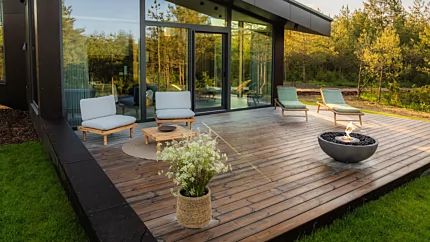
Concrete is the quiet achiever in the salt-air conversation. Chloride attack, the mechanism that destroys coastal metalwork, has no grip on a cast concrete surface, which makes concrete one of the better fire pit materials for salt air, and a reason composite-concrete bowls keep appearing in beachfront projects where steel has failed. It doesn't fade to chalk under UV the way coatings do, and its visual weight anchors a landscape design in a way thin metalwork can't.
The failure modes are different, not absent, and the main one is managed at the point of specification. Engineered composite concrete, the category EcoSmart Fire's Fluid™ Concrete bowls sit in, is formulated for thermal stability; pair it with a contained, even-burning bioethanol fuel and the thermal-shock risk is effectively off the table. In a direct wood fire, the story is different: unrated, site-cast concrete can experience thermo-hygral damage from 220 to 320°C, with surface spalling, fragments breaking away from the face, possible within 10 to 30 minutes of exposure at fire temperatures, according to research by Kumar and Ramesh published in the International Journal of Civil Engineering Research in 2024. Trapped moisture in the concrete turns to steam against intense localised heat, which is why material and fuel choice are inseparable for a long-lasting installation.
The remaining considerations are manageable. Hairline cracking can appear with age and temperature cycling, usually cosmetic. Porous surfaces will hold stains, red wine, leaf tannin, sunscreen, unless sealed; a penetrating sealer reapplied every six months in residential use keeps the surface tight, and the surface must be completely dry before any cover goes on, or you trap the moisture you were trying to exclude. Natural stone and site-built masonry share concrete's strengths and add one more constraint: weight. A masonry fire pit is a fixed installation. You're not rearranging the courtyard around it next spring.
Copper sits at the sculptural end of the market. It will not rust, ever, and its drift from bright salmon to deep brown to blue-green verdigris is part of the purchase. The honest caveats: that patina is uncontrollable, it arrives on the weather's schedule rather than yours, and copper commands a premium-tier price that's hard to justify on durability alone, since other materials match its lifespan at a fraction of the cost. Choose copper because you want a living-finish object in the garden, not because a spec sheet sent you there.
On a coastal balcony or a rooftop terrace, where every kilogram counts and salt is a given, aluminium starts to look tempting, and for good reason. It can't rust, it weighs a fraction of steel, and it handles salt air better than most coated steels. The limitation is heat. Aluminium loses structural strength at fire temperatures well below those steel tolerates, so it appears mainly in surrounds, shells and trims around a contained burner rather than as the fire-bearing structure itself. As a cladding material in a well-engineered design, it earns its keep; as the vessel for a roaring open fire, it's the wrong metal.
The best fire pit material for coastal Australia is not the best material for the Mallee, and a single national recommendation would mislead half the country. The matrix below grades each material against the four broad zones that cover most Australian buyers. It's the synthesis of everything above: let your zone shortlist the material, then let design taste choose within the shortlist. Where a grade reads Poor or Short horizon in your column, the rows above and below it in the same column name the stronger alternatives for that zone.
Two patterns are worth pulling out of the table. First, concrete and 316 stainless are the only materials that grade well everywhere, which is why they dominate premium coastal specification. Second, corten's grades swing harder than any other material's, from the best-in-class choice for a dry inland garden to the one to avoid on a humid coast. No other fire pit material is so completely defined by its postcode.
Material | Coastal QLD / NSW / WA (humid, salt, high UV) | Temperate coastal VIC / TAS / southern WA (salt, milder UV) | Inland temperate (dry, hot summers, cold nights) | Arid inland and tropical north (extreme UV, heat; wet season in north) |
|---|---|---|---|---|
316 stainless steel | Excellent, the metal benchmark near surf | Excellent | Excellent (304 usually sufficient) | Excellent |
304 stainless steel | Good with regular fresh-water rinsing; expect tea-staining beachfront | Very good | Excellent | Very good; rinse in tropical coastal positions |
Corten / weathering steel | Poor, patina won't stabilise in persistent humidity and salt | Fair in open, well-drained positions | Excellent, ideal wet-dry cycling | Good in arid zones; poor in the humid tropics |
Powder-coated steel | Short horizon unless the coating system is exceptional | Fair to good with cover discipline | Good; watch UV chalking on dark colours | Fair; UV is the enemy, specify exterior-grade powder |
Cast concrete / composite | Very good, immune to salt; seal and cover correctly | Very good | Very good | Very good; manage sealer under extreme UV |
Natural stone / masonry | Very good, fixed installation | Very good | Very good | Very good |
Copper | Good, patinates fast and dramatically | Good | Good | Good; rapid patina under intense sun |
Aluminium (surrounds) | Very good for salt; structural limits apply | Very good | Very good | Very good |
If your property sits in a designated bushfire-prone area, material selection picks up a second dimension: not just how the fire pit survives the weather, but how it behaves as an ignition source in a landscape designed to resist one.
Australia's framework here is AS 3959:2018, the Standards Australia document that defines six Bushfire Attack Levels, BAL ratings, and sets mandatory construction requirements for buildings in bushfire-prone areas. The standard governs construction rather than appliances, so there's no "fire pit BAL bushfire rating" as such, but the logic of the standard flows directly into sensible outdoor-feature decisions: in a zone assessed for ember attack and radiant heat, anything in the garden that produces embers deserves scrutiny.
This is where fuel choice intersects with material choice. A wood fire generates exactly the airborne embers and sparks that BAL assessment exists to manage. A contained bioethanol flame produces none: no embers, no sparks, no smoke, no soot. Across our bioethanol fire pits, the flame is a contained, liquid-fuelled burn with nothing solid to eject, which changes the conversation with both your own risk assessment and, in many cases, your insurer's.
Operational restrictions add a seasonal layer that varies by state. In New South Wales, the Rural Fire Service sets the statutory Bush Fire Danger Period from 1 October to 31 March, during which open burning requires a Fire Permit, and permits are suspended entirely on Total Fire Ban days. Victoria's CFA declares Fire Danger Periods municipality by municipality, beginning as early as October in some areas. Other states run their own declared seasons, so confirm dates with your local fire authority rather than assuming the NSW calendar applies; how specific restrictions treat enclosed-flame appliances differs by jurisdiction and by the day's fire danger rating, and we answer the practical version of that question in fire restriction guidance. The structural advantage of a bioethanol fire pit holds regardless of the season's declared dates: no embers means a different conversation with your insurer and your local fire authority than an open wood fire permits, even where the rules still require the flame to stay off on the worst days.
The covered alfresco, a roofed outdoor room off the back of the house, has become the default centrepiece of Australian outdoor living, and it quietly rewrites the fire pit brief. Under a roof, the weathering equation improves for every material: less rain, less standing water, less UV. Corten is the exception, as covered positions can deny it the wet-dry cycling its patina depends on, but stainless, concrete and coated steel all age more gently under cover.
The harder constraint under a roof is the fire itself. Wood smoke under a ceiling is intolerable, and an open flame near roof structure raises clearance questions that an open lawn never asks. This is where bioethanol's fit becomes structural rather than stylistic: it burns without smoke or soot, and within manufacturer specifications it operates without a flue or vent, which is precisely what a roofed outdoor room requires from a fire pit for an alfresco area. The combustion science behind that clean burn is covered in how bioethanol works.
"Within manufacturer specifications" is doing real work in that sentence, and it's worth unpacking. Clearances come first: published guidance for our bioethanol fire pits and fire tables specifies a minimum of 2,000 mm [78.7 in] of overhead clearance above the flame and 600 mm [23.6 in] of side clearance to fixed furniture, which most alfresco ceilings accommodate comfortably but every pergola should be measured against. Air volume comes second. Bioethanol consumes oxygen as it burns, so models carry minimum room-size requirements when used in enclosed or semi-enclosed spaces: the smaller AB3 burner requires a minimum 40 m³ of room volume, while the larger AB8 requires 116 m³. An open-sided alfresco usually exceeds these figures easily, but a fully enclosable outdoor room should be checked against them like any indoor space; the full picture for enclosed settings is set out in ventilation requirements explained. Note too that within a typical range, some models are rated outdoor-only while others are certified for indoor and outdoor use, so the alfresco buyer should confirm the rating of the specific model, not the range in general.
Get the fuel and the clearances right, and the covered alfresco becomes the easiest environment in the country to keep a fire pit looking new.
Maintenance advice that ignores location is half useless. A coastal stainless routine is overkill in Mildura; an inland concrete schedule under-serves the Whitsundays. The table below calibrates the routine to the zone, and the prose after it covers the one habit that applies everywhere.
The habit that applies everywhere is cover discipline, and it's more nuanced than "buy a cover". A quality cover, UV-coated Oxford fabric is the benchmark across our fire pits range, blocks the sun and rain that do the slow damage. A cheap vinyl tarp can do the opposite: it traps humidity against the surface and turns the cover into a corrosion and mould chamber. Whatever you cover, cover it dry, and uncover it regularly so moisture can escape; published care guidance for concrete models is explicit that the surface must be completely dry before covering and should be uncovered periodically to let trapped moisture evaporate.
For bioethanol models, one more habit: keep the burner lid on when the unit isn't running, and if rain does reach an open burner, drain, clean and dry it before refilling, because water contamination dilutes the fuel and prevents a clean light. The full fuel-side routine is short, and our note on ethanol fire pit maintenance walks through it. Small routines, but they're the difference between a fire pit that's weather-resistant on paper and one that's weather-resistant in your backyard.
Zone | Routine | Frequency | Watch-outs |
|---|---|---|---|
Coastal (all states) | Fresh-water rinse of metal surfaces; wipe dry; check coated edges for chips; reseal concrete | Rinse every 2–4 weeks; concrete sealer every 6 months | Tea-staining on stainless if rinsing lapses; salt trapped under covers |
Inland temperate | Wash with mild soap and water; inspect coatings after summer; reseal concrete | Seasonal clean; sealer every 6 months | UV chalking on dark powder coats; frost moisture in burner trays |
Tropical north | Rinse and dry after the wet; ventilate covered units regularly; mould-check concrete and fabric | Monthly through the wet season | Humidity under covers; mould on any surface left damp |
Bushfire-prone | Standard zone routine plus pre-season clear of leaf litter and debris around the unit | Before each fire season | Dry fuel load accumulating around and under the fire pit |
Loading image...
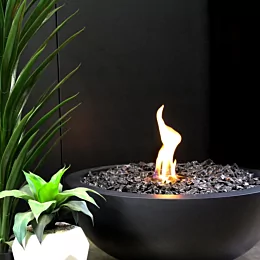
Mix 850 Fire Pit
Loading image...
 © @scenicrimguide @thetamborine
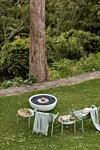
 Mix 850 Fire Pit
Our answer to the Australian conditions described above is built into the material choices rather than added as a coating. Across more than 250,000 installations in 75 countries, the conditions Australian buyers face, coastal salt, intense UV, open-air exposure, represent a well-mapped part of that testing ground. The concrete bowl models in the range are cast in Fluid™ Concrete, a weather-resistant, lightweight composite developed to handle exactly the forces this article has graded materials against: it forms a stain and impact-resistant barrier, protects against environmental weathering under long UV exposure, and its smooth finish repels dust and resists scratches, mould and mildew. It's available in Natural, Graphite and Bone, which keeps the palette working across coastal, native and contemporary garden schemes.
Every burner across the range is Grade 304 stainless steel, with an optional black ceramic coating, paired with surrounds in Fluid™ Concrete or, on the fire table side of the family, Grade A teak that weathers naturally from honey-gold to a silver-grey patina without deteriorating. The same Fluid™ Concrete and Grade A teak construction carries into the fire table range, for buyers whose brief is a dual-function entertaining surface rather than a freestanding bowl. The metal fire pit models in the range use stainless surrounds, brushed Grade 304 on the stainless-finish version and powder-coated Grade 202 on the black versions. On the black models, the Grade 202 surround is paired with a UV-stable powder coat formulated for exterior use, a choice that prioritises the aesthetic of a flat black finish and is best suited to inland or sheltered positions rather than the marine corrosion zone. That's exactly the kind of grade transparency the checklist below asks every manufacturer to provide; coastal buyers can apply the rinsing routine from the maintenance section accordingly.
The third pillar is the fuel. Bioethanol removes the ember, spark, smoke and soot variables entirely, and it removes utility connections too: the fire pits range is freestanding and portable, with no flue, chimney or vent required, so the fire pit can follow the design rather than the gas line. In Australia, the available range is bioethanol, and every fire pit and fire table model is compliant with ACCC recommendations, with UL 1370 listing in the United States and EN 16647 BSI certification in Europe and the UK covering the same designs in other markets. UV-coated Oxford fabric covers are available across the range, with fitted All Seasons Cover variants for the concrete and fire table models, closing the loop on the maintenance routines above.
Every manufacturer will tell you their fire pit is built to last. These ten questions separate the ones who have tested that claim from the ones who have printed it on the packaging. The section above answers them for EcoSmart Fire's range specifically, but any manufacturer should be able to meet the same standard.
Which stainless grade is used, 316, 304 or lower, and is it stated in writing on the specification sheet?
If the product is corten, what is the plate thickness in millimetres?
For powder-coated products: what is the coating film thickness, what pre-treatment is used, and which exterior-grade performance standard does the coating system meet?
Is the powder an exterior, UV-resistant grade, and is colour fade covered by the warranty?
Are edges, welds, fixings and the underside protected to the same standard as the visible faces?
For concrete or composite: what is the material formulation, and is a sealer schedule published?
What clearances and minimum room volumes does the manufacturer publish, and are they specific to each model?
Which safety standards does the product comply with in your market, and can the manufacturer name them?
What exactly does the warranty cover, structural corrosion, coating failure, surface staining, and for how long in coastal positions?
Is a fitted, breathable, UV-rated cover available for the specific model?
Question nine deserves special attention. Many outdoor-product warranties quietly reduce or exclude coverage within a set distance of the coast. If you live near the water, that clause tells you more about the manufacturer's real confidence in their material than any marketing copy does.
Stainless, decisively, provided the grade is right. Grade 316 is the benchmark within the marine corrosion zone; Grade 304 performs well a little further back with regular fresh-water rinsing. Powder-coated mild steel depends entirely on its coating, and the first chip near salt air becomes a creeping corrosion point. Near the coast, buy the alloy, not the jacket.
Yes, during its first year or two of patina development, run-off carries iron oxide that permanently stains pale paving, limestone and light concrete. Plan for it: set the fire pit on gravel, dark pavers or a dedicated drip zone, or pre-weather the steel before installation. Once the patina stabilises, run-off reduces substantially.
Matched correctly to its climate zone, a quality fire pit is a 10 to 20-year purchase. Grade 316 stainless and well-sealed composite concrete sit at the top of that range even on the coast; thick-plate corten matches them inland. Mismatched materials, corten on a humid coast, budget powder coat under tropical UV, can fail in under five years.
Both, depending on the cover and the habit. A breathable, UV-rated fabric cover fitted over a completely dry fire pit protects it; a cheap vinyl tarp thrown over a damp one traps humidity and accelerates corrosion and mould. Always cover dry, choose a breathable UV-coated cover, and uncover the unit regularly so moisture can escape.
Choosing a weather-resistant fire pit in Australia comes down to a single discipline: let the location pick the material before taste picks the model. The forces at work, salt, UV, heat, humidity and bushfire exposure, are mapped, measurable and brutally consistent, and each material answers them differently. Stainless lives or dies by its grade, corten by its wet-dry cycle, powder coat by its coating system, concrete by its sealing routine and its protection from thermal shock. None of these is a flaw; each is simply a condition, and the buyer who knows the conditions holds the advantage over every showroom photograph. Pair the right material with a fuel that removes embers and smoke from the equation, add a maintenance routine calibrated to your climate zone rather than a generic care card, and the weather-resistant fire pit stops being the most vulnerable object in the garden. It becomes the thing the garden is designed around, for the next twenty years of evenings.