
Blog

  /  

Fire Pits for Small Spaces: Balconies, Compact Patios & Apartment Outdoor Areas

Fire Pits for Small Spaces: Balconies, Compact Patios & Apartment Outdoor Areas

A four-metre balcony doesn't feel like fire pit territory. There's a neighbour two metres above you, a railing on three sides, and a body corporate that frowns at barbecues, let alone open flames. So most apartment dwellers and courtyard owners quietly file the idea away with the swimming pool and the vegetable garden: lovely, but not for this place.

The constraint is real; the diagnosis is wrong. The real barriers to fire pits for small spaces have never been the square metres. They're smoke, fixed infrastructure, and clearance, and all three are properties of the fuel and the design, not of the space itself. Choose differently and the balcony fire pit stops being a contradiction. The constraint changes which fire pit you choose, not whether you can have one.

Published:
· Updated:

Loading image...

thumbnail: webimage-T-Lite-8-Designer-FireplaceT-Lite 8 - Private Residence CGI

Can you have a fire pit in a small space?

Yes. You can have a fire pit on a balcony, compact patio, or apartment outdoor area, provided the fuel type, footprint, and clearances suit the setting. Ventless bioethanol designs remove the biggest barriers because they produce no smoke, need no flue or utility connection, and can be moved if the layout changes.

Only three things genuinely disqualify a fire pit from a small space. The first is smoke and emissions: a wood fire on a balcony sends smoke straight into the unit above, and no amount of careful placement fixes combustion chemistry. The second is fixed infrastructure: anything requiring a gas line, a flue, or a permanent connection turns a furniture decision into a building works application. The third is physical clearance: flames need breathing room from walls, railings, overhangs, and furniture, and some designs demand more of it than a compact terrace can give.

Notice what's missing from that list: size itself. A 600 mm [23.6 in] fire pit with clean combustion and sensible clearances is more at home on a balcony than a sprawling wood-burning bowl is in a large backyard under a tree. The question was never “is my space big enough?” It was always “which design respects the constraints I actually have?”

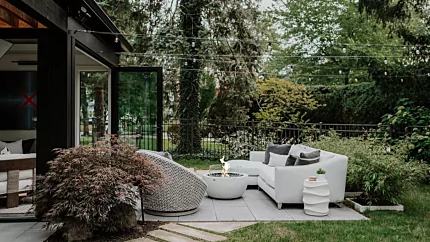
Why fuel type decides everything in a compact space

In a generous garden, fuel choice is mostly about preference. In a small space, it's the whole decision, because each fuel behaves differently under exactly the constraints that define balconies and courtyards.

Wood is the obvious casualty. Smoke drifts wherever the wind sends it, which in an apartment building means into open windows and across washing lines. Embers travel. Ash needs cleaning out and somewhere to go. And the fuel itself claims storage space you don't have: a log store on a two-metre balcony is a punchline, not a plan. Even designs marketed as smokeless reduce smoke rather than eliminate it; secondary combustion helps once the fire is hot, but start-up and burn-down still produce visible smoke, which is precisely when your neighbours are paying attention.

Gas solves the smoke problem but introduces a placement one. A plumbed gas line fixes the fire pit to one spot forever and usually requires licensed installation, while bottled gas means storing and swapping cylinders in a space where every cubic metre is accounted for. Either way, the fire stays where the fuel tells it to.

Bioethanol behaves as though it was engineered for this exact scenario, because it was. Clean combustion of liquid bioethanol releases only heat, water vapour, and CO₂: no smoke, no ash, no soot, no odour clinging to cushions. Ventless bioethanol fire pits need no flue, no chimney, and no utility connection, so they arrive as furniture rather than as a building project, and they can move when your layout, or your lease, does.

Factor

Wood

Gas

Bioethanol

Smoke and odour

Smoke drifts to neighbours; designs labelled smokeless still produce some

None

None

Infrastructure

None, but ember and ash management needed

Fixed line or bottle storage

None; fully ventless

Placement flexibility

Limited by smoke and ember behaviour

Fixed once plumbed

Freestanding and relocatable

Fuel storage

Log store required

Cylinder storage required

Compact sealed bottles

Suits shared buildings

Rarely

Sometimes, with approvals

Yes, with standard clearances

One distinction worth holding onto: ventless means no flue or chimney is required, not that fresh air is irrelevant. Any flame consumes oxygen, so good airflow is part of responsible use, particularly in covered or semi-enclosed settings. The difference is that bioethanol asks only for the airflow a normal outdoor or well-ventilated space already has, not for a hole in the roof.

Matching the fire pit to your space type

Small spaces aren't interchangeable. A windswept seventh-floor balcony, a covered ground-floor patio, and a walled courtyard each impose different constraints, and the right format follows from the constraint, not from a generic “compact” label.

Balconies and apartment outdoor areas

Balconies are the most constrained setting of all: overhead coverage from the balcony above, neighbouring units on either side, wind exposure that changes by the hour, and a floor surface you may not be allowed to modify. They also involve carrying everything, fuel included, through a lobby and up a lift.

What suits them is a small-footprint, freestanding, ventless design you can position with clearances in mind and reposition when the furniture changes. Within our fire pits range, the compact models start at footprints around 556 to 600 mm [21.9 to 23.6 in] square, light enough for one or two people to move. The Nova 600, the lightest and lowest-profile concrete model in the range, was designed with balcony use squarely in mind: a low cast-concrete bowl that reads as sculpture when unlit.

A quick balcony check before you commit:

  • Measure the floor area and confirm you can keep flames at least 600 mm [23.6 in] from fixed furniture and structures

  • Check overhead: a minimum of 2,000 mm [78.7 in] of clearance from movable items above the flame

  • Confirm the surface is solid and even; never grass, artificial turf, or carpet, and the air gap beneath the unit's feet must stay clear

  • On a gusty aspect, choose a sheltered evening rather than fighting the wind; part of the pleasure of a compact outdoor fire is that it rewards the calm moments

Hardwood decking is workable provided the prescribed clearances are maintained; the freestanding bioethanol models in the range are designed to sit on combustible decking without a separate protective barrier, thanks to the mandatory air gap their feet preserve.

One regulatory note for readers in the United States: NFPA 1 restricts the use of outdoor heating appliances on balconies of multi-family buildings, so apartment dwellers there should confirm what their local fire code and building management permit before buying. The NFPA's guidance on appliance placement is the right starting point. Rules differ markedly between jurisdictions, and interpretations vary with the local authority having jurisdiction, which is one more reason the permissions conversation below matters.

Compact and covered patios

Covered patios swap the balcony's wind problem for an overhead one. The roofline sets your vertical clearance budget, and the semi-enclosed structure changes how air moves, so placement is about respecting the 2,000 mm [78.7 in] overhead clearance and keeping the flame away from the seating that naturally crowds a small patio.

Low-profile formats earn their keep here. A shallow bowl that sits barely above knee height keeps generous distance between flame and roof while putting the fire at the visual centre of a seated group; the Mix 600, the circular low-profile bowl in our fire pits range, was made for exactly this kind of setting. Because covered patios usually host furniture already, a fire feature that doubles as a surface, or sits comfortably within an existing furniture arrangement, makes better use of the footprint than a tall standalone piece ever could.

Courtyards and small terraces

Courtyards have hard boundaries on every side: fences, walls, neighbouring plantings, sometimes a tree leaning over from next door. The temptation is to treat the constraint as a reason to go small and apologetic. The better move is the opposite: one statement piece scaled to the space, positioned with at least 2 m [6.5 ft] from trees and clear of fence lines. The Pod 30, a 762 mm [30 in] bowl in our fire pits range, sits in exactly this register: scaled for a courtyard rather than a balcony, it anchors a walled space without overwhelming it.

There is a reason architects across 75-plus countries keep returning to this move. Dezeen's outdoor fireplaces lookbook is full of compact courtyards organised around a single fire feature, because in a walled space the fire does the work that a view does elsewhere: it gives every seat something to face. A portable model means you can find that perfect position by trial rather than by guesswork, shifting the piece until the sightlines from the kitchen window, the bench, and the back door all agree.

Loading image...

thumbnail: webimage-Pod-30-Fire-PitPod 30 - bldc design © @dawncookdesign @bldcdesign / Photo: @suzuranphotography

Building rules, body corporate approval and shared spaces

For apartment dwellers, the first hurdle isn't clearance or fuel. It's permission. Shared buildings layer several rule sets on top of each other: body corporate or strata bylaws (HOA rules in some markets), the terms of a rental agreement, building-management policies, and your insurer's expectations. None of these is a reason to give up; all of them are reasons to check before you buy.

Every fire pit in our range is certified to UL 1370 in the USA and EN 16647 BSI in Europe and the UK, and complies with Australia's ACCC mandatory standard, which references EN 16647. That means the documentation you need for a body corporate approval request already exists. And smoke-free, ventless designs change the conversation itself. A request to run a wood fire on a balcony is, reasonably, a hard no in most buildings. A request to use a freestanding, certified bioethanol fire pit that produces no smoke, requires no installation, and makes no modification to the building is a different proposition, closer to approving a barbecue than a fireplace. Having that documentation in hand turns an awkward conversation into a short one.

Before you buy, work through this list:

  • Read your bylaws or HOA rules for clauses on open flames, heaters, and balcony use

  • If renting, get the owner's written agreement

  • Ask building management whether smoke detectors, sprinklers, or insurance conditions affect balcony flames

  • Gather the product's certification documents and specifications to submit with any approval request

  • Check fuel storage limits; standard retail bioethanol bottles sit well under typical indoor storage permit thresholds

  • Confirm how seasonal fire restrictions apply where you live

That last point deserves emphasis. Bioethanol fire pits are not exempt from total fire bans. Fire authorities such as CFA Victoria make clear that all fires for warmth or comfort, including fire pits, are prohibited on declared ban days, and that includes clean-burning fuels. Plan around your local restrictions the way you would for any flame.

Small space, big presence: making the fire pit the centrepiece

Here is the reframe that changes the buying decision. In a large garden, a fire pit is one feature among many. In a 10-square-metre courtyard or on a balcony, it's the room's anchor, which means design quality matters more in a small space, not less. It's a setting we know well: EcoSmart Fire has placed ventless bioethanol fire features in more than 250,000 installations across 75-plus countries, and apartment balconies and compact courtyards are where this technology made its name.

The data on how we now design outdoor areas backs the instinct: a NAHB survey of more than 300 residential architects and designers found 73 per cent include fire pits or fireplaces in their outdoor living designs. And as the Australian Bureau of Statistics has documented, new apartments average around 60 per cent of the floor area of new houses, so for a growing share of households, the small outdoor space is the only outdoor space. It deserves the best object in the home, not the leftover one.

Practically, the centrepiece principle means three things. Choose one well-designed piece rather than scattering several small elements; a single confident form organises a tight footprint, while clutter shrinks it. Favour scale and proportion over raw size; a low, wide bowl can feel more generous than a tall column in the same area, because it leaves the sightlines open. And treat material and finish as part of the space's palette: a cast-concrete bowl in a bone or graphite finish reads as sculpture by day and hearth by night, holding the space together even when unlit.

One flame, two settings: the indoor-outdoor advantage

The evening starts on the covered patio, the temperature drops faster than forecast, and instead of abandoning the fire, you carry it inside. Conventional fire pits can't offer that scenario at all.

A portable ventless bioethanol fire pit makes it genuinely possible, with conditions. Within our fire pits range, the Stix fire pit is the model built for exactly this crossover: a compact 556 mm [21.9 in] steel-rod sculpture, light enough to relocate, rated for indoor and outdoor use, and freestanding with no connection to undo. Its AB3 burner runs for 8 to 11 hours on a single 2.65 L [0.7 gal] fill, so one fuelling comfortably covers an evening that moves between settings. Other compact models in the range are outdoor-only, or require additional accessories for indoor use, so check the rating of the specific model before planning the crossover.

What changes when the flame comes inside is the environment around it, and indoor use has specific requirements. The floor must be hard and level, never carpet. Room volume matters: the AB3 burner needs a minimum room volume of 40 m³ [1,413 ft³], roughly a medium living room. And fresh airflow remains essential, because every flame draws on the room's air. Meet those conditions and the payoff is a fire feature that earns its place across the whole year and the whole home, not just the three warm months and the four outdoor square metres.

How to choose: a small-space selection checklist

Everything above collapses into a decision sequence you can run in an afternoon:

  1. Measure the space. Record the floor area, then map where a flame could sit with 600 mm [23.6 in] lateral clearance from fixed furniture and structures and 2,000 mm [78.7 in] overhead clearance from anything movable above it.

  2. Confirm rules and permissions. Bylaws, rental agreement, building management, insurer, and local fire restrictions, before money changes hands.

  3. Choose the fuel for the setting. In a shared building or tight footprint, ventless bioethanol removes smoke, infrastructure, and storage barriers in one decision.

  4. Match the format to the space type. Compact freestanding pieces for balconies; low-profile bowls for covered patios; one well-scaled statement piece for courtyards.

  5. Check surface compatibility. Solid, even, and stable; hardwood decking works with clearances maintained; grass, artificial turf, and carpet never do.

  6. Plan fuel storage and refuelling. Sealed bioethanol bottles store compactly for up to three years; when it's time to refuel, let the burner cool fully, move to a ventilated spot, and decant carefully rather than pouring straight from the bottle.

  7. Weigh the dual-function and portability premium. A model that moves between settings, or doubles as furniture, returns more use per square metre than any fixed feature can. If the flame will burn indoors, keep it supervised; an indoor fire should never burn unattended.

  8. Keep the maintenance picture in mind. Bioethanol leaves no ash or soot, so upkeep amounts to keeping the burner clean and the fuel sealed; budget your effort accordingly.

If a model clears all eight steps, the small space was never the problem.

The space was never the problem

The doubt that opens this decision, “my outdoor area is too small for a real fire”, turns out to be aimed at the wrong target. Smoke, infrastructure, and clearance were the actual barriers, and each one belongs to the fuel and the design rather than to the floor plan. A ventless bioethanol fire pit dissolves the first two outright and makes the third a matter of measurement rather than compromise.

What's left is the better question: which single, well-made piece deserves to anchor the space? Because that's the quiet advantage small-space owners hold over everyone with a sprawling garden. Their fire pit doesn't compete for attention. It is the view. Choose it the way you'd choose the most visible object in your home, and the smallest outdoor area in the building becomes the one everyone wants an invitation to.

References

Related Articles

Fire Pits

The Essential Guide to Fire Pits

Buying Guides
Learn everything you need to know to select the ideal fire pit for your outdoor space and lifestyle.

10 Stunning Fire Pit Design Ideas to Transform Your Outdoor Space

Design Trends
There's something primal and deeply satisfying about gathering around fire - it transforms any outdoor area into a magnetic gathering point where conversations flow as freely as the flickering light.

Fire Pit Entertaining Guide: Creating the Perfect Outdoor Gathering Space

Design Trends
How to design a fire pit gathering space that runs itself for any occasion.

Ventilation Requirements for Indoor Fire Pits: What You Must Know

Safety
Indoor fire pit ventilation rules: room volume, clearances and certified ESF models.

Weather-Resistant Fire Pits: Best Materials for Australian Conditions

Buying Guides
Compare fire pit materials for Australian conditions — coastal, UV and heat.

Ethanol Fire Pit Installation: No Gas Lines, No Electrical Required

Installation
Install an ethanol fire pit with no gas line, no electrician, no permit.

Portable Ethanol Fire Pits: Perfect for Indoor and Outdoor Use

Buying Guides
Portable ethanol fire pits: move indoors or outdoors, no flue needed.