Loading image...


Why the freestanding format changes the environmental equation
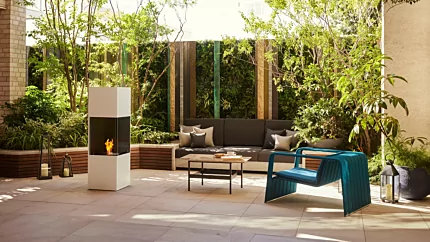
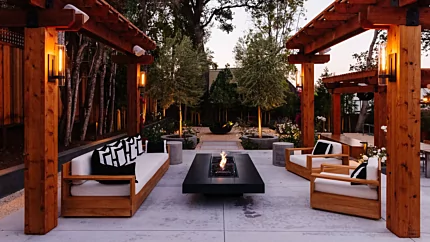
Freestanding fireplaces remove a layer of the environmental story most comparisons skip entirely: the building works. A fire that needs no chimney, no flue penetration, no gas line, and no hardwired circuit avoids a whole category of construction that carries its own footprint long before a single flame is lit. For the broad view of the category, our freestanding fireplaces collection is a useful starting point.
That hidden cost rarely makes it into a fuel-versus-fuel debate, yet it is real. Cutting a flue through a roof, running a gas line, or framing a masonry chimney all consume materials, labour, and structural alteration, and the embodied carbon in that work does not disappear because the fire later burns cleanly. A freestanding unit sidesteps the lot.
Infrastructure has an environmental cost too
The infrastructure a freestanding format avoids is easy to underestimate. Stripped to the essentials, here is what the format does without:
A masonry or steel chimney and the structural support it demands
A flue penetration through ceilings, walls, or roofline
A connected gas line and its associated fittings
A dedicated hardwired electrical circuit
Each of those items has to be manufactured, transported, and installed, and several of them permanently alter the building. None of it is counted when a fireplace is judged purely on what comes out of the flame. Looked at honestly, vent-free fireplace emissions are only one part of a fuller picture that includes the carbon never spent on construction in the first place.
Portability and zone heating as a sustainability behaviour
Placement freedom turns into an environmental behaviour the moment you use it to heat only the room you are in. Rather than warming an entire house to keep one living space comfortable, a freestanding fire lets you concentrate heat where people actually are. The US Department of Energy notes that zone heating can produce energy savings of more than 20 per cent compared with heating the whole area of a house.
Sustainability engineer Smith Mordak, Director of Sustainability at Buro Happold, frames this neatly, describing the idea of reducing the heat generated inside a building as a concept that bridges behaviour change and building design. A fire you can reposition is a small piece of that bridge. It nudges the household toward heating habits that use less energy without anyone feeling colder, which is the kind of low-effort behaviour change that tends to actually stick.