Loading image...
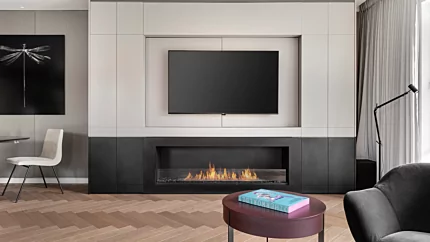 © Herbert / Architecture: @taltamir_architecture.design / Photo: @odedsmadar
 Flex 68SS Single Sided Fireplace
A single-sided fireplace asks the room to look at one wall, and one wall only. That is the whole proposition. When the focal point is unambiguous, the rest of the design relaxes around it: the sofas know where to face, the joinery knows where to stop, the ceiling line knows where it wants to draw the eye. The format is now the default for new builds and renovations where the brief calls for a clean architectural anchor rather than a 360-degree centrepiece.
The harder question is which single-sided fireplace to specify, in what size, with what burner, and where in the floor plan. That decision usually arrives mid-project, with structural drawings half-locked, a cabinetmaker waiting on a frame opening, and a client asking for warmth in the room by autumn. The pages that follow walk through the considerations that move a single-sided spec from idea to installed, with the EcoSmart Flex SS range as the working example.
Loading image...
© Herbert / Architecture: @taltamir_architecture.design / Photo: @odedsmadar Flex 68SS Single Sided Fireplace
Most fireplace decisions begin with one question: where does the fire need to be visible from? When the answer is a single primary zone — a living room with a clear sightline, a primary suite designed around a long view, a hospitality lobby with one approach axis — the format that wins is the single-sided fireplace.
It is the same logic that drives gallery curators: when the eye has one wall to read, the wall has to earn it. A double-sided unit splits attention across two rooms and demands matched material treatments on both faces. A single-sided unit concentrates the design budget on one face and lets the other side of the wall stay structural. For the broader head-to-head between the two formats, the comparison guide on the cluster page covers that decision in full.
The EcoSmart Flex SS range was built around exactly this format. Twelve widths, zero-clearance installation into framed openings, bioethanol fuel that needs no flue or gas line, and certification for both indoor and outdoor use. Within our single sided fireplaces collection, the Flex SS series covers everything from a 578 mm [22.8 in] insert in a study alcove to a 4-metre [13 ft] feature wall in a hotel lobby, on the same framing logic.
Most regret on a fireplace purchase traces back to a decision that was skipped, not one that was wrong. Working through the seven decisions below in order keeps the brief honest and stops the spec from being driven by the fireplace that happens to be in stock.
Fuel. Bioethanol, vented gas, or electric. This is the most consequential decision because it dictates installation complexity, flue requirements, indoor air dependencies, and ongoing fuel sourcing.
Location. Indoor, outdoor, or both. The Flex SS range is rated for either, which keeps the brief flexible into design development.
Heat output. What the fire needs to do thermally — primary heat source, supplementary heat on shoulder seasons, or atmosphere only.
Size and viewing width. How wide the visible flame needs to be, measured against the wall it sits in and the room it serves.
Burner configuration. All Flame, Box Left, Box Right, or Two Boxes — this is where the visible flame profile is chosen.
Install context. Joinery, masonry, drywall framing, outdoor enclosure, or cabinetry. The frame opening logic is the same; the surrounds are not.
Running costs and fuel sourcing. Fuel cost per hour, hours per evening, and whether high-purity bioethanol is available in the local market.
These are not sequential gates so much as overlapping constraints. A coastal alfresco brief, for example, settles the fuel and location decisions immediately and reduces the burner-configuration decision to the units rated for that exposure. A heritage apartment renovation rules out flues before the heat output question is even on the table.
For most single-sided briefs, bioethanol is the fuel that opens the most placement options. There is no flue, no gas line, no electrical chase for an active flame, and no chimney load on the structure above. The fire becomes a furniture-style insert rather than a building system.
The combustion case is straightforward. Bioethanol burns to water vapour and carbon dioxide in a closed chamber, with no soot and no particulate matter to vent. There is no flue, which means there is no flue gas loss. By contrast, a traditional open-hearth gas or wood fireplace loses a significant share of its combustion heat up the chimney; even modern direct-vent gas inserts route their exhaust outside the building envelope. The heat that bioethanol generates stays in the room it was generated in. That principle is what makes the fuel viable in cabinetry installs, heritage walls where no chimney exists, apartment renovations where a flue cannot be added, and outdoor enclosures where venting infrastructure would be disproportionate to the project.
There is a sustainability layer that follows from the same chemistry. Bioethanol is produced from agricultural feedstock, and the carbon dioxide released during combustion is the same carbon dioxide the source crop absorbed during growth. According to the US Department of Energy's Alternative Fuels Data Center, corn-based ethanol reduces lifecycle greenhouse gas emissions by an average of 40% against the fossil-fuel baseline. Peer-reviewed work by Jeswani, Chilvers and Azapagic published in the Proceedings of the Royal Society A reports that biofuels can achieve reductions of up to 60% under favourable feedstock conditions. Ventilation still matters — a single-sided ethanol fireplace operates with the room's air, not a sealed combustion path — but adequate room volume and normal household ventilation are designed-for from the moment the unit is sized.
A short comparison is worth making explicit:
Bioethanol — no flue, no gas line, indoor and outdoor compatible, fuel sourced in litres or gallons, ignition manual.
Vented gas — thermostatic control, requires gas connection and flue, indoor-only in most certifications, capital cost and install lead time both higher.
Electric — no real combustion, plug-in operation, atmosphere only without meaningful primary heat at architectural scale.
Loading image...
Sizing a single-sided fireplace works on three inputs at once: the volume of the room it serves, the area it is expected to heat, and the wall width it is sitting against. Get any of these wrong and the fire either underperforms the space or fights the architecture.
Room volume sets the floor. EcoSmart publishes minimum room volumes for every burner in the Flex SS range so that combustion runs comfortably without depleting the room's air; this is the figure to check before any other. Heating area sets the working range, and wall width sets the design ceiling — a 4-metre [13 ft] feature wall reads thin behind a 1-metre [3.3 ft] flame.
The Flex SS series spans twelve widths on a constant frame envelope. Frame opening depth holds at 365 mm [14.4 in] and frame opening height holds at 730 mm [28.7 in] across every model. Only the width changes. That single architectural decision is what lets a project move up or down a size during design development without re-cutting the joinery section drawings.
Model | Width | Heat output | Heats up to | Burn time |
|---|---|---|---|---|
Flex 18SS | 578 mm [22.8 in] | 2 kW [5,800 BTU/hr] | 20 m² [215 ft²] | 8–11 h |
Flex 32SS | 1,011 mm [39.8 in] | 3.4 kW [11,430 BTU/hr] | 40 m² [431 ft²] | 10–13 h |
Flex 42SS | 1,265 mm [49.8 in] | 4 kW [13,650 BTU/hr] | 50 m² [538 ft²] | 9–12 h |
Flex 50SS | 1,471 mm [57.9 in] | 4.4 kW [15,000 BTU/hr] | 60 m² [646 ft²] | 8–13 h |
Flex 60SS | 1,725 mm [67.9 in] | 4 kW [13,650 BTU/hr] | 50 m² [538 ft²] | 9–12 h |
Flex 68SS | 1,930 mm [76 in] | 4.5 kW [15,290 BTU/hr] | 65 m² [700 ft²] | 9–14 h |
Flex 78SS | 2,187 mm [86.1 in] | 4 kW [13,650 BTU/hr] | 50 m² [538 ft²] | 9–12 h |
Flex 86SS | 2,390 mm [94.1 in] | 8.8 kW [30,000 BTU/hr] | 120 m² [1,292 ft²] | 8–13 h |
Flex 104SS | 2,850 mm [112.2 in] | 9 kW [30,580 BTU/hr] | 130 m² [1,399 ft²] | 9–14 h |
Flex 122SS | 3,310 mm [130.3 in] | 13.2 kW [45,000 BTU/hr] | Refer to spec | 8–13 h |
Flex 140SS | 3,770 mm [148.4 in] | Refer to spec | Refer to spec | Refer to spec |
Flex 158SS | 4,030 mm [158.7 in] | 13 kW [45,870 BTU/hr] | 195 m² [2,099 ft²] | Refer to spec |
A practical heuristic: pick the model whose width sits within the visual band of the wall it occupies — neither lost on the wall nor pressed against the wall's edges — and then verify that the heat output covers the room and that the room volume satisfies the minimum for that burner. Open-plan layouts often pull the choice up a size because the heat zone extends past the immediate room, while compact spaces are usually well served by the 18SS through 50SS band.
Burner configuration is the single biggest lever on how the fireplace reads visually. The Flex SS series uses four configurations, each driven by where the AB-series and XL-series ethanol burners sit inside the frame.
All Flame configurations run a continuous flame the full width of the opening. The visual is one uninterrupted line of fire, and the heat output is maximised because the burner volume is at its largest. This is the configuration that suits long, gallery-style feature walls and any installation where the flame is the dominant horizontal element in the room.
Box Left and Box Right are asymmetric configurations. A single burner sits at one end of the opening, with the remainder of the cavity available for decorative or structural composition — a stacked-stone column, a vertical timber slat run, or a sculptural sculpture of unburnt logs. These configurations suit rooms where the architecture already has a centre of gravity and the fire needs to play a supporting role rather than dominate.
Two Boxes sets two burners at the outer edges of the opening, leaving a central span between them. The visual is symmetrical, with flame at each shoulder of the opening and a calm centre — the centre often gets a decorative log set or charcoal accessory to read as a single composition. This configuration is particularly suited to formal rooms and entries where symmetry is doing structural work in the design.
Across the configurations, decorative accessories such as the Log Set Copper and the Black Glass Charcoal can be specified to soften the burner reveal and tie the firebox into the surrounding material palette. Burner choice — AB3 for the smallest units, scaling through XL500, XL700, XL900, and XL1200 — follows from the configuration and the model width.
Every model in the Flex SS range is certified for indoor and outdoor installation. That dual rating is unusual in the category and removes one of the most common late-stage spec headaches: discovering that the unit specified for the living room is not approved for the alfresco it later moved to.
Indoor placements lean on the Flex SS frame's zero-clearance behaviour. The frame can sit directly inside joinery, masonry, or framed drywall, with the burner recessed into a chase that finishes flush with the wall plane. The most common indoor briefs are feature walls in living rooms and primary suites, joinery integrations in studies and libraries, and lobby installations in hospitality projects where the fireplace is the first sightline on entry.
Outdoor placements use the same frame logic in alfresco kitchens, pool houses, covered terraces, and rooftop bars. The burner technology and frame materials carry the same certifications outdoors as indoors, but two things change: the surrounding enclosure has to allow the airflow the burner expects, and exposure to driving wind has to be considered during siting. A fully enclosed outdoor room behaves more like an indoor room with strong ventilation; a partly exposed terrace behaves like an exterior environment and needs the burner positioned out of the prevailing wind path.
Shared across both contexts, the room or enclosure has to satisfy the minimum-volume rule for the chosen burner, and the surrounding materials within the heat zone have to be non-combustible. Those two requirements travel with the unit regardless of which side of the building envelope it lives on.
Loading image...
Installing a Flex SS unit is closer to fitting a piece of architectural joinery than to building a fireplace. There is no chimney, no flue, no gas connection, and no dedicated electrical circuit. The unit drops into a framed opening, is fixed in place, and the surround is finished around it. Time on site for a properly prepared opening is typically under an hour.
Two clearance numbers carry the project. The flange sits 180 mm [7.1 in] from the floor, and the burner edge sits 55 mm [2.2 in] above the firebox floor. The frame opening itself is built to a depth of 365 mm [14.4 in] and a height of 730 mm [28.7 in], constant across every model. Only the opening width changes with model selection. This consistency is the practical reason the Flex SS range slots cleanly into mid-project specification changes — the joinery shop drawings only need a width adjustment, not a full redraw.
Three rules of thumb sit on top of the dimensions:
The frame is not load-bearing. It carries the unit and the surround, not the wall above. Lintels, headers, and structural framing remain the responsibility of the wall design.
All materials within the heat zone must be non-combustible and meet ASTM E 136 or equivalent. This rule covers the firebox face, the immediate surround, and the soffit above the opening.
The glass windscreen is part of the certified assembly. Removal voids the warranty and changes the combustion behaviour the unit was certified to. It stays in.
The other thing that surprises first-time specifiers is how few trades the installation needs. A framing carpenter prepares the opening, a finisher dresses the surround, and the unit goes in. There is no gas fitter, no electrician, no chimney sweep, and no rendering crew unless the design calls for one.
A single-sided Flex SS ethanol fireplace consumes between 0.31 and 2.61 litres [0.08 and 0.69 gallons] of bioethanol per hour, depending on burner size and flame setting. A typical evening — two to four hours of continuous flame — translates into a fuel cost band that is broadly comparable with running a high-output gas appliance for the same duration, and meaningfully lower than the install-amortised cost of a vented gas system over the first five years of ownership.
The capital-versus-operating split is the more useful framing. Bioethanol units carry a lower install cost because there is no flue, no gas line, no chimney structure, and no electrical infrastructure. That capital saving sits against a per-hour fuel cost that the owner controls directly through use patterns. A gas alternative inverts the ratio: higher capital and install commitment, lower running cost when the burner is throttled by a thermostat. An electric alternative removes the running-cost question for primary heat — but it also removes the live flame, which for most single-sided briefs is the entire reason the format was chosen.
Fuel sourcing is regional. In Australia, the United States, Canada, and the United Kingdom, e-NRG bioethanol is available direct from the brand network in pack sizes appropriate to local market norms — litres in AU and UK, gallons and quarts in US and CA. In the European Union, e-NRG is not currently distributed; specifiers source equivalent high-purity bioethanol from regional suppliers. Storage is the part owners get wrong most often: fuel containers stay sealed, kept away from heat sources, and burners are refilled only once they have fully cooled. None of this is more demanding than any household combustible fuel.
For specifiers, the Flex SS range condenses into a small set of values that move directly onto the architectural drawings and the material schedule.
Frame opening constants — depth 365 mm [14.4 in], height 730 mm [28.7 in] across the range. Width varies by model.
Heat-zone materials — non-combustible to ASTM E 136 or equivalent within the published clearance envelope. Mantel and soffit clearances follow the unit's installation manual; combustible mantels can be specified above the clearance line.
Trades — framing carpenter for the opening, finisher for the surround. No gas, no electrical, no mechanical ventilation tied to the unit.
Fuel and ventilation — minimum room volume must be satisfied per the selected burner. Normal habitable-room ventilation is the design baseline; sealed or pressure-controlled rooms require additional review.
The range carries category recognition that often supports the specification choice in front of a client or planning authority. The 2020 BIMsmith Best Award and the 2018 Attendees Choice Award speak to the unit's adoption inside the design and BIM communities, which matters when the spec is being signed off alongside other building-system components. Even in mid-stage design development, the constant frame envelope and the predictable trades list keep the unit easier to absorb into a project than most other architectural fire elements.
The Flex SS proposition becomes clearer in side-by-side framing. Where vented gas wins is on thermostatic precision and unattended runtime; where bioethanol wins is on placement flexibility, sustainability, and indoor-outdoor versatility. Where electric wins is on absolute simplicity; where it loses, for this format, is that the visible element is no longer a real flame.
Bioethanol single-sided | Vented gas single-sided | Electric single-sided | |
|---|---|---|---|
Flue / vent requirement | None | Required | None |
Indoor / outdoor rating | Both | Indoor (typical) | Indoor |
Real flame and heat | Yes | Yes | Simulated |
Install lead time | Hours | Days to weeks | Hours |
Capital cost | Lower | Higher | Lower |
Operating cost | Moderate, fuel-driven | Lower when thermostatic | Lowest |
Compared with other ethanol systems on the market, the differentiator is the architectural envelope: twelve widths sharing one frame depth and height, indoor-and-outdoor certification across the entire range, and a configuration system that adapts the visual flame to the room without changing the structural opening. The detailed head-to-head against double-sided formats is covered on the cluster pillar for readers carrying that question through to specification.
A single-sided fireplace is a decision about where the room's attention goes, and the Flex SS range answers it with a consistent architectural envelope, a fuel chemistry that travels easily across project types, and a configuration vocabulary that lets the visible flame settle into the design rather than dominating it.
The decisions worth pausing on are the early ones — fuel, location, heat, and width — because they cascade into everything else. Once those are settled, the rest of the spec moves quickly: frame opening to a constant depth and height, materials to a familiar non-combustible schedule, install through two trades, fuel through a regional channel. The format is no longer a building system to negotiate; it is a design element to place.
The fireplace, in the end, is doing a quieter job than the brief usually acknowledges. It is giving the room a direction to face. When the chosen format respects that brief, the architecture stops working around the fire and starts working with it.