Loading image...
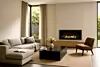

Frame 1000SS Single Sided Fireplace
The wall facing the sofa is the wall the room remembers. Everything else, the rug, the art, the joinery, arranges itself around it. So when that wall holds a single-sided fireplace, the decision is not really about a fireplace at all. It is about what the room’s anchor is going to be, and how confidently you let it speak.
A single-sided fireplace feature wall design earns its presence by combining a real flame with an uninterrupted surface. The flue is gone, the chimney chase is gone, the structural carve-outs are gone. What remains is a clean opening, a viewing aperture set into whatever material the architecture is asking for, and a flame that behaves like part of the composition rather than something bolted onto it. That shift, from appliance to architecture, is what makes the format so quietly powerful.
Loading image...
Frame 1000SS Single Sided Fireplace
A feature wall lives or dies on three things: a continuous surface, a single dominant focal point, and the freedom to choose the right material. A single-sided fireplace delivers all three by removing the constraints that have historically dictated where and how a fireplace can sit in a room. EcoSmart Fire has put real-flame bioethanol fireplaces into more than 250,000 spaces across 75 countries, and the Flex SS range is the most specified single-sided format in that portfolio.
The first advantage is the flush surface. Because the firebox sits inside the wall cavity with a single viewing pane, the surrounding plane stays unbroken. There is no protruding hearth box pulling the eye outward, no chimney breast rising behind it, no return wall folding around a corner. The wall reads as one continuous gesture, and the fireplace reads as a controlled aperture within it. That is the whole grammar of a feature wall, and the single-sided format speaks it natively.
The second is the absence of a flue. A traditional fireplace forces the architecture to host a vertical chimney chase that rises through every floor above, with structural penalties, weather flashings, and the loss of usable wall and ceiling area along the way. A flueless single-sided fireplace takes the chimney out of the equation. The wall can be located anywhere the floor plan benefits from a focal point, including positions a flued fireplace could never reach: against an internal partition, under a stair void, behind a bedhead, set into a courtyard wall facing the pool.
The third is design freedom over the surround. With a zero-clearance, real-flame fireplace from the single-sided fireplaces collection, the surround does not have to be a code-mandated non-combustible apron of tile or stone within a fixed dimension of the firebox. It can be the material the room wants: large-format porcelain, microcement, end-grain timber, fluted plaster, blackened steel, hand-troweled lime. The fireplace stops dictating the material conversation and starts taking part in it.
NFPA 211, the chimney-system standard, governs the clearance world a flued fireplace must obey. A flueless bioethanol fireplace sits outside that scope entirely, which is what gives architects and specifiers the latitude to compose the wall the way they would compose any other architectural surface in the project.
Before anything is chosen, the wall itself has to be chosen. A feature wall is not the wall with the most space. It is the wall the room is already orienting itself toward, the wall the sofa faces, the wall you see first when you walk in from the hallway, the wall the dining table looks at across an open plan. Find that wall and the rest of the planning becomes structural rather than aesthetic.
Vertical position is the next decision. Three options dominate contemporary work. A floor-level fireplace, with the burner trough close to the floor plane, reads as the most grounded and pairs well with low-slung furniture. A raised hearth-line position, with the viewing aperture lifted to roughly seat height, brings the flame into the eye line of someone sitting on the sofa, which is the most experientially direct setup for a living-room conversation pit. A mid-height linear placement, where the aperture floats around 1,000 mm from the floor, is the dominant move in contemporary architecture and sits comfortably below a piece of art or a wall-mounted screen.
Proportion is where most feature walls succeed or fail. A long horizontal aperture, where the viewing width is two-thirds or more of the host wall’s width, gives the room a calm, cinematic flame. A narrow aperture on a wide wall reads as undersized unless flanking joinery brings the composition back into balance. Width across the Flex SS range is the only variable, with overall depth held uniformly at 365 mm [14.4 in] across every model, which means the planning conversation stays focused on horizontal proportion without depth ever entering the equation.
Sight lines deserve a moment of their own. Stand where the primary user will stand, sit where they will sit, and walk where they will walk. If the flame disappears behind a sofa back, raise the aperture. If it competes with a window directly opposite, you have a daytime glare problem that needs solving with shading rather than relocating the fireplace. The work that goes into reading the room before you commit to the wall is the work that makes everything afterwards look effortless.
Loading image...

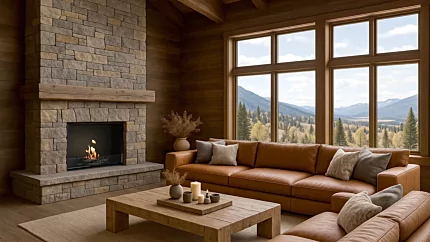
Heritage 42SS Single Sided Fireplace
The cladding around the fireplace is the part of the project the eye lands on most. Material does most of the speaking, and the single-sided format gives the material space to speak.
Natural stone and marble carry the weight of permanence. A book-matched marble slab running floor-to-ceiling with the aperture cut directly into it reads as architectural, the kind of move that makes the room feel as though it was built around the flame from the first set of drawings. Travertine, with its softer striations, brings warmth to a Mediterranean palette. Honed limestone steadies the room and gives the flame a quieter chromatic neighbour, so the fire reads as the warmest object in the composition without having to fight for it. Stone is non-combustible, which means it can sit close to the firebox opening without the clearance buffer combustible materials demand, and the visual continuity from cladding to aperture stays uninterrupted.
Large-format porcelain has quietly become the material of choice for many contemporary projects. 3,200 mm by 1,600 mm slabs let a wall be clad with one or two seams instead of a tile grid, which closes the gap between a tiled wall and a single-material slab without the cost or weight that natural stone at that scale demands. Marble-effect porcelain holds the visual richness of stone without the porosity, and the surface stays consistent in colour and tone across the full wall in a way that natural material rarely guarantees. For a feature wall where the fireplace is the only break in an otherwise uninterrupted surface, this is often the cleanest result the budget allows.
Timber needs more care. As a combustible material, it sits within a different clearance regime than stone or porcelain. The flueless fireplace allows timber on a feature wall, but the burner manufacturer’s manual will dictate exactly how close it can come to the firebox opening, and a non-combustible buffer of stone, steel, or porcelain framing the aperture is the standard move. Done with intent, the contrast between a charred-oak field and a fine steel-bordered aperture is one of the most striking compositions in contemporary work, and the timber’s grain catches the flicker in a way smoother materials never quite reproduce.
Concrete and microcement bring a quiet, monolithic register. Polished concrete, board-formed concrete, and microcement applied on-site each deliver a continuous, seamless surface that suits a fireplace better than almost any other material. A wall finished in a single sweep of microcement, with a horizontal aperture floating in it, becomes one gesture rather than several.
Brick keeps coming back. Slim-format brick, lime-washed brick, end-grain reclaimed brick, and engineered brick slips all sit comfortably around a flueless fireplace because the material is itself non-combustible. The texture catches firelight in a way smooth surfaces cannot, and the result reads as both contemporary and quietly historical.
Steel handles the most reductive compositions. Blackened mild steel, hot-rolled steel, brushed stainless, and powder-coated finishes all suit the single-sided format because the cladding can be brought right up to the firebox opening without thermal compromise. The vocabulary is industrial; the restraint is luxurious.
The advantage that runs through every one of these material choices is the same: no flue means no chimney chase, no penetration through the upper floors, no compromise on what the surface above the fireplace becomes. The wall stays the wall, all the way to the ceiling.
Four layout patterns recur across the projects that get this right. Each has a different spatial personality, and each rewards a different room.
A floor-to-ceiling layout treats the entire host wall as the feature. The cladding runs uninterrupted from the floor plane to the ceiling line, and the fireplace sits as an aperture within it. This pattern asks the most of the material and the room, and it pays back in proportion. In a room with a high ceiling, the floor-to-ceiling move turns the fireplace wall into a single architectural event.
A raised hearth-line composition lifts the fireplace off the floor and treats the lower portion of the wall differently. The hearth-line is often the seat height of the adjacent sofa, which keeps the flame in the conversational eye line. A stone or concrete plinth below the aperture, with cladding above, creates a horizontal datum that the rest of the room can negotiate with.
Asymmetric placement is the bolder move. The aperture sits off-centre on the wall, balanced by joinery, art, or a window on the other side. Done well, the asymmetry feels considered rather than mistaken, and it suits open-plan rooms where a centred fireplace would compete with another focal element.
A framed-aperture composition treats the fireplace opening as a deliberately punched window in the wall. The frame is often a contrasting material, blackened steel against pale plaster, brushed brass against concrete, polished stone against timber. The aperture reads as a viewing portal onto the flame, almost picture-like, which suits gallery-style interiors and minimalist hospitality spaces.
Loading image...

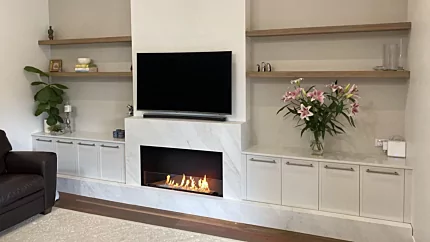
Flex 42SS Single Sided Fireplace
A fireplace rarely lives alone on a feature wall. Joinery is what turns the wall from a single architectural statement into a usable, lived-in piece of the room.
Symmetrical flanking joinery is the most classical move. Identical cabinet runs to the left and right of the fireplace settle the composition and read as quietly formal. The eye centres on the flame, the joinery holds the balance, and the room feels resolved. This works particularly well in main living rooms and bedrooms where the wall is intended to read as deeply considered.
Asymmetric joinery is the contemporary counterpart. A tall cabinet column on one side and an open shelving stack on the other, or a deeper bench-and-storage unit on one side with a vertical art panel opposite. The composition reads as deliberate without feeling formal, which suits open-plan rooms where the feature wall is one part of a larger spatial choreography.
Open shelving and closed cabinetry each have a role. Open shelving sets the wall up for objects, books, ceramics, framed photographs, that animate the surface. Closed cabinetry keeps the wall calm and disciplined, with the fireplace as the only visual incident. Mixing the two, with closed lower cabinetry and open upper shelving, gives the wall layered functionality without losing the focal hierarchy.
A bench seat is a small move that can transform the room. A built-in bench, often in stone or timber, running below the fireplace at hearth height becomes an additional sitting position oriented directly at the flame. In a family room or a hospitality lounge, it changes the social geometry of the space.
And finally, negative space. A feature wall needs places where nothing is happening, so the parts that are happening have somewhere to land. Resist the temptation to fill every flanking surface with shelving and panelling. The flame benefits from quiet space around it.
Loading image...
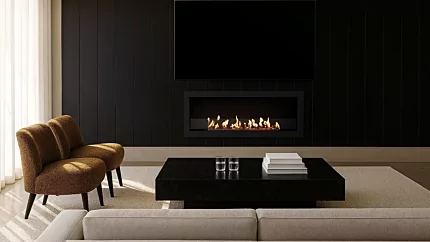
Frame 1200SS Single Sided Fireplace
Yes, a television and a fireplace can share the same feature wall. The instinct that they cannot is mostly historical, anchored to the era of mantelpieces and rising heat plumes. A flueless single-sided fireplace, with its precisely managed flame plane and zero-clearance certification, makes the combination workable. The question is how, not whether.
There are three approaches that hold up under contemporary planning. The first is the TV directly above the fireplace, separated by a non-combustible mantel or ledge that acts as a heat shield and visual divider. This is the most space-efficient option and the most common in apartments and smaller living rooms. The second is the TV in a recessed niche set at least 300 mm above the fireplace opening, with the niche itself acting as a frame. This treats the TV as a deliberate architectural inclusion rather than an afterthought. The third is the TV on an adjacent wall, with the fireplace anchoring the primary feature wall and the screen treated as a secondary element. This is the cleanest design solution and the one that gives the fireplace the most uncontested focal authority.
Whichever route the project takes, the work happens at planning stage. AV manufacturer heat tolerance specifications need to be confirmed in writing, the mantel or shield needs to be detailed before the trades arrive, and the cabling pathway needs to be designed into the wall cavity rather than retrofitted after. Interior designer Shane Inman has identified seven layout solutions for the TV-and-fireplace problem, and the recurring thread across all of them is that the composition needs a precise plan rather than an improvised compromise.
A feature wall lit only by the flame loses its full presence. A feature wall over-lit by overhead downlights loses the flame. The work is in the layering.
A three-layer layered lighting approach, built from ambient, accent, and task tiers, translates directly to a fireplace feature wall. The ambient layer is the room’s general illumination, dimmable, low-key, and warm in colour temperature. The accent layer picks out the architectural features of the wall itself, the texture of the stone, the joints in the brickwork, the edges of the joinery. And the flame becomes the third light source in its own right, a low, warm, flickering presence that the other layers are designed to support rather than overwhelm.
Warm colour temperature matters more than most planning decisions acknowledge. Research by Golshany and Elzeyadi found that lower correlated colour temperature, around 2,800 K, supports mental comfort, and that nonuniform peripheral lighting outperformed uniform overhead illumination for stress reduction. A feature wall lit with 2,700 K to 3,000 K wall washers, with the room’s overhead lighting dimmed, gives the flame the chromatic space to dominate the warm end of the spectrum. Cooler lighting around 4,000 K fights the flame and pulls the eye toward the ceiling rather than the fire.
Dimmability is non-negotiable. Every circuit on or around the feature wall needs to be on a dimmer, and ideally on a scene controller so the room can move smoothly from daytime brightness to evening intimacy without manual fiddling. A small detail, but one that decides whether the wall feels lived-with or showroom-staged.
The same single-sided fireplace behaves differently depending on what room it sits in. Some short observations on each.
In a living room, the feature wall is usually the wall the sofa faces. A horizontal aperture at mid-height pairs naturally with a low sectional and a wall-mounted screen or art panel. A floor-to-ceiling stone or microcement treatment turns the room into a destination rather than a passageway.
In a main bedroom, the feature wall is most often the bedhead wall facing the foot of the bed, or, in larger suites, an adjacent wall facing a window-side reading position. A narrower aperture suits the more intimate scale of the room, and the flueless format means the fireplace can sit directly behind or beside the bed without ventilation constraints that would once have made the move impossible.
In a dining room, the feature wall sits across the long axis of the table. The flame becomes part of the dinner-table choreography, a steady ambient presence at sightline height that lifts the room’s atmosphere without competing with conversation.
In an entry or hallway, a narrow feature wall with a low horizontal aperture turns arrival into an experience. Guests cross the threshold and meet a real flame within seconds. The first impression of the home shifts from a coat rack to an architectural moment.
In a spa or ensuite, where steam, calm light, and material warmth define the experience, a small feature wall with a slim aperture creates an entirely new register of bathing. Stone or microcement around the firebox is the natural pairing because both materials handle ambient moisture comfortably.
In hospitality, the feature wall scales up. The Trailborn Highlands hotel in North Carolina, designed by LOVEISENOUGH, features a central fireplace in the lobby lounge and three more in the restaurant, with each one acting as a social anchor that gives guests an instinctive sense of where to settle. Hospitality Design documented the build in September 2024, and the underlying observation is portable: a real-flame focal point in a public space generates dwell time more reliably than almost any other architectural decision.
Loading image...
Frame 1500SS Single Sided Fireplace
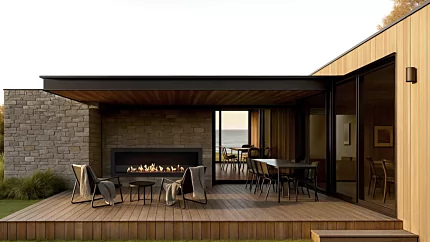
A feature wall does not stop at the building envelope. Outdoor spaces benefit from the same architectural logic, and the flueless format extends naturally into the garden because the same models in the Flex SS range are rated for both indoor and outdoor use, with no separate outdoor variant required.
A garden wall fireplace turns a previously decorative boundary into a destination. A concrete or stone wall at the far end of the garden, with a horizontal aperture set into it, gives the garden a sightline that draws people through the space and a reason to be out there once the sun has gone. Dezeen's 2021 lookbook of architect-designed outdoor spaces showed a raised concrete hearth hosting an ethanol fire anchoring a ground-floor courtyard, and the move works because the wall and the flame are doing the same architectural job, just outside.
A pool-house or pavilion wall pairs the fireplace with a covered structure that can stay in use through cooler months. The fireplace becomes the reason the pavilion gets used in autumn and again in early spring. With outdoor overhead clearance of 2,000 mm from the burner, the pavilion roof needs to be planned with that dimension in mind rather than discovered halfway through the build.
A courtyard or terrace wall is the most contained outdoor application. A small enclosed courtyard, framed by walls on three sides, with a horizontal aperture set into the dominant wall, creates an alfresco room that behaves more like an indoor space than a garden. This is the move that turns a difficult, narrow city site into the most-used part of the home.
Material choice outdoors needs to respect weather. Natural stone, porcelain, brick, and concrete handle outdoor exposure without compromise. Stainless steel components stay in good condition with prompt rinsing after salt air or pool-chemistry exposure and a cover when the fireplace is not in use, the same maintenance rhythm as any quality outdoor stainless fitting.
The outdoor section shows how far the format travels. Back indoors, the flueless advantage plays equally well in both directions, and renovations and new builds approach a feature wall from different starting points.
In a renovation, a feature wall is often the most efficient way to reorient a room. A second-floor living room that has lost its way under previous interventions can be reset around a new feature wall in a few weeks of work, and the absence of a flue means no roof penetrations, no structural carve-outs through the floor above, no HVAC re-routing. The wall cavity needs to accommodate a uniform depth of 365 mm [14.4 in] across every Flex SS model, which is shallow enough to fit a stud wall or a furring zone built over an existing partition without losing meaningful floor area. KPMG’s Renovation Domination analysis of ABS data found that renovation spending reached 40% of total Australian residential construction in 2023–24, up from 34.2% five years earlier, and the appetite for architectural intervention in existing homes is showing every sign of continuing.
Apartments are the strongest case for the flueless single-sided format. Strata regulations, shared walls, and the absence of any feasible chimney route ruled out a traditional fireplace in most multi-residential builds. The flueless construction removes every one of those constraints, which is why these fireplaces appear so often in penthouse renovations where the architectural ambition is high and the building services are not.
In a new build, the feature wall can be designed in from day one. Framing depths, joinery interfaces, electrical runs for lighting circuits, and structural offsets for any cantilevered hearth can all be coordinated at design stage rather than retrofitted. The result is a feature wall where every detail looks intentional because every detail was intentional.
The trade coordination story is also worth a word. A flued fireplace involves the structural engineer, the roofing contractor, the chimney installer, the HVAC team, and the gas fitter in addition to the cladding trades. A flueless installation removes most of those interfaces. Framing carpenter, electrician for the lighting, cladding trade, and the fireplace install itself. Fewer trades on site, fewer handoffs to coordinate, faster overall delivery.
A feature wall built around a ventless single-sided fireplace earns its sustainability credentials in several quiet ways at once.
The fuel itself is renewable. e-NRG bioethanol is fermented from sugarcane or corn rather than extracted from fossil reserves, and a 2022 lifecycle assessment by Morales-Vera and colleagues, published in MDPI’s Fermentation journal, found that bioethanol from poplar biomass returned a net global warming potential of −1.05 × 10⁻³ kg CO₂-eq per MJ on a cradle-to-grave basis. The figure is for poplar feedstock specifically, but the underlying mechanism, atmospheric carbon captured during biomass growth offsetting the carbon released during combustion, holds across plant-based feedstocks.
No chimney structure means no embodied carbon in masonry, no roof penetration, and no upper-floor structural work. A masonry chimney is a substantial commitment of cement, steel, and energy; removing it from the project removes all of that.
Heat is delivered without venting loss. Where a vented gas fireplace can lose around 30% of its heat output up the flue, a flueless bioethanol fireplace returns its full heat into the room. That changes the appliance’s role in the room’s thermal performance, particularly in shoulder-season conditions where the fireplace is the supplementary heat source rather than the primary one.
The renovation footprint is smaller, too. No demolition for a chimney chase, no debris from roof penetration, no waste stream from removing an old fireplace setup. The wall is built or rebuilt around the new aperture, and the work is finished.
Indoor bioethanol installations work well when room volumes are matched to burner output. The published minimums span 40 m³ at the smallest configuration up to 345 m³ at the largest All Flame configuration in the Flex SS range, and the specification conversation always includes the room as well as the fireplace. Research by Vicente and colleagues, writing in the Journal of Hazardous Materials (March 2026), confirms that ventilation is the determining variable: when the room is correctly sized and ventilated, indoor performance is comfortable and well within recognised air-quality thresholds.
A handful of avoidable mistakes recur often enough to be worth naming.
Choosing the wall before reading the room. The wall that looks most empty in plan is often the wall the room is not actually oriented toward. Walk the room before drawing on it.
Over-decorating the feature wall. A feature wall is a focal point, not a scrapbook. If the cladding is doing the work, joinery and styling around it should step back. The flame needs room to be the lead actor.
Ignoring sight lines. A flame that lands behind a sofa back, or directly opposite a daytime-bright window, is a flame that loses its presence at exactly the times the room is being used.
Mismatching material temperature. Cold-toned stone against a warm timber floor reads as accidental unless the rest of the room is intentionally cool. The feature wall has to sit inside the room's existing palette, not announce a new one.
Lighting that fights the flame. Cool-temperature downlights directly above the fireplace pull the eye upward and flatten the flame. Warm, dimmable wall washers do the opposite.
Treating the fireplace as the only design move. A feature wall is part of the room, not a substitute for the room being designed. The rug, the furniture, the joinery, and the lighting are still the rest of the work.
For the specifier, the integration story comes down to a small set of decisions that get easier the earlier they are made.
Rough opening planning is the first. The framework opening sits at 365 mm depth and 730 mm height across every model in the Flex SS range, with overall unit dimensions held uniformly at 365 mm [14.4 in] deep and 807 mm [31.8 in] tall, and width as the only variable. That uniformity makes specification simpler than it looks. The drawing changes with the chosen viewing width, but the depth and the framing logic stay constant across the line.
Self-supporting framing is the second. The unit is not load-bearing, which means anything that sits above the aperture, joinery, art, a television, plaster, or simply the rest of the wall, must be supported by the building structure on its own. This is a routine carpentry detail, not a complication, but it needs to be drawn rather than assumed.
Material thermal behaviour is the third. Non-combustible materials such as stone, concrete, porcelain tile, brick, and stainless steel can be brought closer to the firebox opening than combustible materials like timber and MDF. Two separate clearance regimes apply, and the exact dimensions are diagram-based in the Flex fireplace installation manual rather than being a single number that fits in body copy. For early-stage specification, treat the regimes as a binary, plan the immediate surround as non-combustible, allow combustible cladding beyond that perimeter.
Viewing-area choices are the fourth. Width across the line scales from 378 mm [14.9 in] viewing width on the smallest model to a 4,030 mm [158.7 in] viewing width on the largest, with heat output scaling alongside. Width drives the proportional ambition; room volume drives the burner choice. Room volume needs to match burner output, with published minimums spanning 40 m³ at the smallest configuration up to 345 m³ at the largest All Flame configuration. The match between room volume and burner choice is more important than the match between room size and viewing width. The published room volume minimums per burner configuration are the starting point; the Flex SS installation manual and EcoSmart Fire’s specification team can confirm the match for any given project.
Trade coordination, finally, is the workflow advantage that most specifiers underestimate the first time they spec a flueless single-sided fireplace. Flueless fireplaces simply require fewer trade interfaces, fewer sequencing decisions, and faster site delivery.
Certifications underwrite the spec. The Flex SS range carries UL 1370 certification in the United States, EN 16647 certification (BSI) in the European Union and United Kingdom, and is compliant with ACCC recommendations in Australia. Compliance is in place; the spec conversation can move directly to design.
Loading image...

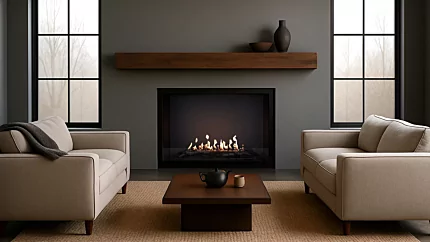
Heritage 56SS Single Sided Fireplace
A single-sided fireplace feature wall design is, in the end, an exercise in restraint. The flueless format takes away the obstacles, the flue, the chimney, the structural carve-outs, the trade interfaces. What it gives back is the freedom to make the wall behave like architecture rather than housing for an appliance. The material can run. The proportion can settle. The flame can sit inside the composition rather than disrupt it.
The work that makes a feature wall succeed is mostly invisible by the time the room is finished. Choosing the wall the room is already pointing toward. Setting the proportion before the cladding arrives. Lighting the surface in a way that supports the flame rather than competing with it. Letting negative space breathe. Planning the joinery and the television and the cabling at design stage so nothing reads as retrofitted after the fact.
A feature wall like this rewards the room over a long horizon. The flame is not seasonal, the material does not date if it has been chosen with intent, and the wall continues to anchor the space through every subsequent change in furniture, art, and styling, which is more than most design decisions manage over the life of a home.