Loading image...
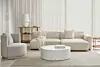
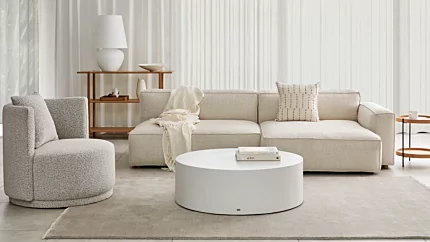
Concrete used to live in the carpark, not the lounge room. Twenty years ago, suggesting a concrete coffee table to a client would have raised eyebrows; today it is the kind of piece interior editors specify for cover features and design-led hotels brief into their lobby refresh. The material has moved indoors, and it has done so on its own terms, bringing weight, texture, and a quiet permanence that polished veneers cannot fake.
The arrival is not a fashion accident. Concrete coffee tables sit at the intersection of three trends that show no sign of fading: a renewed appetite for tactile, natural surfaces, a preference for furniture that earns its keep over decades rather than seasons, and a sustainability conversation that finally rewards materials engineered for longevity rather than disposability. Designed well, a concrete coffee table is the rare piece of furniture that becomes more compelling with age, picking up the soft patina of a thousand small interactions without ever looking tired.
This guide covers the questions buyers actually wrestle with before committing. How heavy is it really. Will it crack. How do you seal it, how often, and what changes if you take it outside. How do you style something with that much visual gravity without the room feeling stiff.
Loading image...
The short answer is density. Concrete carries a presence in a room that lighter materials cannot match, even at the same physical dimensions. A glass top floats. A timber slab warms. A concrete surface sits. It announces itself as a fixed point the rest of the room arranges around. For some interiors that gravity is exactly what is missing; for others it would dominate. Knowing which camp your room is in is the first decision a concrete coffee table asks you to make.
The material itself is a composite, not a single substance. According to the US Federal Highway Administration's reference guide, standard concrete is roughly 25 to 40 percent cement paste and 60 to 75 percent aggregate by volume, with a typical water-to-cement ratio around 0.5 and a unit weight of 2,240 to 2,400 kg/m³. Translated to furniture terms, that means the surface texture, the colour pull, and the edge profile you see on a finished table are all shaped by the recipe rather than applied later. Concrete is not coated to look like concrete; it is concrete, all the way through.
Finishes vary more than people expect. A polished surface reads almost like stone, with the soft sheen of a well-cured floor in a gallery. A more matte finish keeps the small surface variations visible and lets the material's tactile character carry the piece. Pigment can be integrated through the mix to give muted neutrals like the Natural, Graphite, and Bone tones Blinde Design works with, all of which sit comfortably alongside oak, walnut, brass, and the warmer end of contemporary fabric palettes. Compared with timber, which moves seasonally, and glass, which shows every fingerprint, a sealed concrete surface stays dimensionally stable and is forgiving of daily life in a way few materials are.
A common assumption, particularly on home improvement forums, is that a concrete coffee table weighs upwards of 200 lbs and needs four people to shift. That used to be broadly true. It is not true anymore, and the gap between expectation and reality is the single biggest source of hesitation among first-time concrete buyers.
The shift comes from a class of materials called glass-fibre reinforced concretes. By blending a high-strength cementitious matrix with fibre reinforcement, the resulting composite delivers comparable surface hardness at a fraction of the weight of conventional cast concrete. The concrete furniture specialists at Elementi describe glass-fibre reinforced concrete as offering excellent strength, weatherproof performance, and extreme resistance to knocks, scratches, and loads, retaining shape and effect even after years of use. That description matters because it sets a different baseline than the carpark-bollard reputation the material is still living down.
Blinde Design's Fluid Concrete Technology sits in this lineage. Two adults can move most of our coffee tables range without specialist equipment, which sounds mundane until you imagine the alternative: an immovable centrepiece that prevents you from ever rearranging the room. Lightness here is not a compromise on density or feel. The pieces still read as concrete to the eye and to the hand. They simply do not punish you for changing your mind about the lounge layout.
The other piece worth knowing is that lighter does not mean weaker. Modern fibre-reinforced composites can match or exceed standard cast concrete on key performance measures while solving the weight problem that kept the material out of upstairs apartments and timber-floored homes for decades. A well-engineered concrete coffee table is a different object today than it was in 2005, and the assumptions inherited from that era are now worth retiring.
Loading image...


Concrete's reputation for durability is well earned. Roman engineers built concrete structures more than two thousand years ago, several of which are still standing. The modern furniture-grade equivalent does not need to last quite that long, but the underlying material logic is unchanged: cement, water, and aggregate, bound through a chemical reaction that continues to develop strength long after the surface looks dry.
That reaction is hydration. As Penn State University's engineering library explains, Portland cement derives its strength from a series of chemical reactions between cement and water that generate heat and form new crystalline compounds, including calcium silicate hydrate, which is the principal binder holding the material together. Strength develops fastest in the first few days and continues to climb for months, with the internal pH stabilising around 12, a highly alkaline environment that, incidentally, makes the surface naturally resistant to many of the substances that would stain or etch softer materials.
Cracking is the question that comes up next, and it deserves a direct answer. Hairline surface marks can develop in any concrete over time, particularly where the piece has been exposed to thermal extremes or has taken a sharp impact at the edge. Structural cracking, the kind that compromises the piece, is rare in furniture-grade concrete that has been properly mixed, cured, and reinforced. A landmark peer-reviewed overview frames durability through the lens of permeability: the lower the water-to-binder ratio and the denser the matrix, the longer the material resists physical and chemical attack. Furniture-grade concretes are designed at the favourable end of that curve.
Staining is mostly a sealing question. An unsealed concrete surface will absorb red wine, olive oil, and citrus juice the way a sponge would; a sealed surface will not. UV exposure is the other variable, and it is where indoor and outdoor specifications diverge. Some sealers protect beautifully indoors but yellow or chalk under direct sun; others handle the weather but feel wrong in a living room. Choosing the right one matters more than choosing the right amount.
Sealers fall into two broad families and a useful hybrid. Penetrating sealers soak into the concrete's pore structure and react chemically inside the surface, leaving no visible film. Film-forming sealers sit on top, like a thin, often glossy coating. Each has trade-offs.
Darcy Boyle's overview at Prosoco is the clearest published comparison. Silane and siloxane penetrating sealers rate 10 out of 10 for water resistance and are largely invisible. Polyurethane film sealers rate 9 for scratch resistance and suit high-traffic indoor surfaces. Epoxies are excellent on chemicals but poor on UV stability (3 out of 10) and so are unsuited to anything that will see daylight outdoors. Polyaspartic sealers strike a useful balance for outdoor-leaning applications, rating around 8 for UV resistance. The choice depends on what you want the piece to live through.
For furniture specifically, concrete artisan Buddy Rhodes recommends hybrid reactive sealers, which combine penetrating chemistry with a thin surface micro-coating. The penetrating layer reacts with calcium hydroxide deep in the pores, while the surface layer builds protection over the first one to two months of use. The result is a sealer that works indoors and outdoors without the moisture-trapping risk of pure film coatings, and that improves with time rather than degrading from day one.
The advantage of Blinde Design's Fluid Concrete is that the surface is engineered to require very little of you. Soap and water on a soft cloth handles routine cleaning. There is no monthly waxing ritual, no specialist polish, no annual professional reseal. Spills are wiped, not chased. We push the material at the manufacturing stage so the owner does not have to compensate for it later. The cleaning routine for a concrete coffee table should not be more demanding than the cleaning routine for the rest of the room.
Loading image...
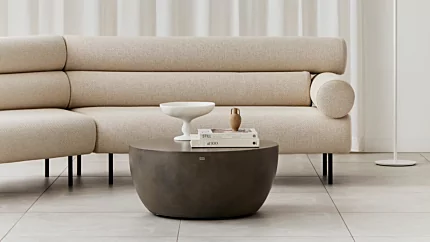
Coffee tables are the one piece of furniture in a living room that everyone touches, leans on, and walks past several times an hour. Getting the proportions wrong means living with the consequence every day. A few rules of thumb help.
For length, aim for a table that runs roughly two-thirds the length of the sofa it faces. Significantly shorter and it disappears; significantly longer and it crowds the seating. For height, sit on the sofa and look at the cushion top: the table surface should sit within a few centimetres of that line, ideally a touch lower so drinks and books are easy to reach without leaning forward. For clearance, leave comfortable passage between the sofa edge and the table edge, enough room for legs to pass easily and for anyone to reach across without stretching.
Shape is the part that interacts most with the rest of the room. A few quick framings:
Round and oval tables soften traffic flow in tight rooms, work well in homes with young children since there is no sharp corner at hip height, and pair naturally with rectangular sofas where the contrast of curve against line is what makes the composition.
Square tables suit symmetrical layouts and modular sofa configurations where the table sits centred in the available space.
Rectangular tables work hardest in long, open-plan rooms where a low horizontal element ties the seating zone together and gives a generous surface for trays, books, and the casual collapse of a magazine pile.
The Blinde coffee tables range covers all three shape families, and that breadth matters because shape decisions tend to be driven by the room, not the brand. A round Curv or Circ piece reads differently from a rectangular Dash 50 or a chunkier Move 65, and the choice is best made in front of the empty space, not in a showroom.
Loading image...


Coffee table styling is one of those design topics with more advice than is useful. The single principle worth keeping is the rule of three: three distinct items or clusters at varied heights, mixed materials, with structure provided by a book stack or a tray and visual interest by mixing circles with squares. Beyond that, concrete asks for slightly different treatment than wood or glass would.
The first adjustment is texture contrast. A concrete surface has visual weight; pairing it with more weight on top, such as heavy bronze pieces and dense stone objects, flattens the composition. The pieces that sing on concrete are the ones that contrast with it: a slim ceramic vessel, a sprig of olive or eucalyptus in soft leather binding, a single matte ceramic bowl with the curve catching light off the matte surface beneath. Textiles help too. A linen runner, a folded throw across one corner, or a low-pile rug visible underneath softens the material's quiet authority without diluting it.
The second adjustment is colour discipline. Concrete sits in the neutral family, but each piece has a temperature. Natural pulls slightly warm, Graphite reads cool, Bone is the closest to off-white. Build the styling around the table's temperature: warm woods and brass with Natural, deeper greens and matte black with Graphite, soft creams and pale oak with Bone. The styling does not need to match; contrast is welcome. But the underlying temperature decision keeps the room coherent.
By design language, a few quick alignments. Minimalist interiors favour one or two larger objects rather than a dense cluster, with the table surface itself doing most of the visual work. Industrial schemes lean into the material honesty: raw timber, blackened steel, leather. Japandi pairings reward soft, sculptural ceramics and a single botanical element with deliberate space around it. Coastal rooms appreciate the surprise of concrete's coolness against linen, rattan, and pale timber floors, and the contrast keeps the scheme from sliding into pastiche.
A small aside worth offering: some of the most striking concrete coffee table styling we have seen had nothing on it. A single ceramic bowl, off-centre, and the rest of the surface left empty. The material was the styling. Not every room is brave enough for that, but it is worth remembering that the table itself is already a design statement, and that styling can subtract as effectively as it can add.
Loading image...
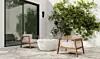

Most furniture materials force a choice: indoor or outdoor, never both. Concrete refuses that choice when it is engineered correctly. A well-formulated concrete coffee table can live in a lounge room in winter, move to a covered terrace in summer, and weather a few unexpected southerly fronts without complaint.
What makes that possible is the combination of material and sealing. The same hybrid reactive sealing approach that suits indoor furniture also suits outdoor exposure, provided the formulation is UV stable. Blinde Design's Fluid Concrete is designed to handle moisture, UV, and temperature swings as a default condition, not an upgrade. There is no separate indoor and outdoor line; the same piece works in both.
The styling shifts seasonally. Outdoors, the table earns its keep as a serving surface: drinks, platters, a citronella candle in summer; folded throws, a small bowl of pine cones, a lantern in cooler months. Indoors, the rules from the previous section apply. Moving a piece between rooms or onto a terrace twice a year is one of the small luxuries the material allows, and it doubles the value of the investment without doubling the inventory.
A note on snow and frost. Concrete is not damaged by cold; it is damaged by freeze-thaw cycles where water has penetrated the surface and then expanded as it froze. A properly sealed concrete coffee table is impermeable enough to make that risk negligible in most climates, but in genuinely punishing winters, bringing the piece undercover or onto an enclosed porch is sensible practice. The same is true for any high-end outdoor furniture.
Loading image...


Concrete has an image problem on sustainability, and the image is not entirely undeserved. MIT's Climate Portal reports that cement production is responsible for approximately 8 percent of all global CO₂ emissions, driven by the chemical reaction releasing CO₂ from limestone and the fossil fuels burning to heat kilns to roughly 1,450°C. A 2023 UNEP report developed with Yale University identifies buildings and construction as 37 percent of global greenhouse gas emissions, with embodied carbon from materials projected to grow proportionally as operational emissions fall.
That is the macro picture. What changes the calculus for individual products is what goes into the mix. Supplementary cementitious materials, such as fly ash, slag, and calcined clays, replace a portion of Portland cement with industrial by-products that would otherwise head to landfill, and PEC Consulting Group has documented that this can reduce greenhouse gas emissions by more than 20 percent. Ground granulated blast-furnace slag in particular can replace up to 40 percent of Portland cement while improving long-term strength and durability. A 2024 peer-reviewed study by Orozco and colleagues, cited by 97 researchers, confirms that fly ash and slag as supplementary cementitious materials enhance sustainability while maintaining material performance.
Blinde Design's Fluid Concrete uses 95 percent recycled materials and produces 90 percent fewer pollutants than conventional Portland cement, and the finished piece is 100 percent recyclable at end of life. That is meaningful on its own, but the broader sustainability case is also about lifespan. Forta Corporation notes that correctly constructed and maintained concrete can last up to 100 years, a duration that comfortably outlasts most timber and almost all plastic furniture. A piece bought once and kept for forty years has a fundamentally different carbon profile than one replaced every six. Material durability is the quiet half of the sustainability conversation, and concrete is one of the few furniture materials that delivers it without compromise.
Loading image...
A concrete coffee table is not a passive object. It anchors the room, sets a temperature, invites a certain way of styling, and rewards a certain way of living: slower, more tactile, less precious about small marks and more interested in long use. Choose the proportions and the shape with the room in mind, choose the colour with the existing palette in mind, and choose a maker who has solved the weight, sealing, and material problems before the piece arrives.
Do all of that and the table earns its place quickly, then continues earning it for decades. Few furniture decisions deliver that kind of return.
Modern fibre-reinforced concrete coffee tables are noticeably lighter than the conventional cast-concrete pieces most people picture. Two adults can typically move a coffee table from the Blinde Design range without specialist equipment, which makes seasonal rearrangement and indoor-to-outdoor moves practical.
Hairline surface marks can develop in any concrete over many years, particularly at sharp impact points. Structural cracking is rare in furniture-grade concrete that has been properly mixed, cured, and reinforced. Fibre-reinforced composites are engineered to resist impact loads that would chip softer materials.
For Blinde Design Fluid Concrete, soap and water on a soft cloth handles routine cleaning. There are no specialist polishes or waxes required. Spills should be wiped reasonably promptly, and abrasive scourers should be avoided since they can dull the surface over time.
Blinde Design coffee tables arrive ready to use; the sealing is built into the manufacturing process and does not require ongoing reapplication under normal use. For artisan-made concrete furniture from other makers, sealing frequency varies; check the maker's specific guidance.
Yes, when the piece is engineered for outdoor use. Blinde Design's coffee tables are designed for both indoor and outdoor environments, with resistance to moisture, UV, and temperature variation built into the material. In genuinely harsh winter climates, undercover storage is sensible practice for any outdoor furniture.
A coffee table that runs roughly two-thirds the length of the sofa it faces, sits at or slightly below the sofa cushion height, and leaves comfortable passage between the sofa edge and the table will work in most living rooms. The Blinde coffee tables collection covers a range of dimensions to match different room sizes and seating configurations.
Concrete furniture's sustainability case rests on two factors: the composition of the mix and the lifespan of the finished piece. Blinde Design's Fluid Concrete uses 95 percent recycled materials, produces 90 percent fewer pollutants than conventional Portland cement, and is 100 percent recyclable. Combined with a material lifespan measured in decades, the lifetime carbon profile compares favourably with shorter-lived alternatives.