How to Create a Cozy Atmosphere with Indoor Ethanol Fireplaces

An indoor ethanol fireplace creates a cozy atmosphere by combining the primal visual warmth of a real dancing flame with clean, ventless operation: no smoke, no installation barriers, no compromise on air quality. A living, moving light source that no electric substitute can replicate, producing gentle radiant heat and the kind of stillness that makes a room feel genuinely inhabited.This article covers how to choose the right model for your space and mood, where to position it for maximum atmosphere, how to style around it, and why its clean-burning nature is as much a comfort advantage as an environmental credential.
Published:
· Updated:

Why a real flame is the foundation of a cozy atmosphere

There is something physiologically distinct about being near a real fire. Research by Christopher Dana Lynn at the University of Alabama found that exposure to fire, specifically the audiovisual combination of flickering light and warmth, produced measurable blood pressure reductions in a randomised study of 226 adults, with systolic pressure falling by 5.9 mmHg over a 15-minute exposure. The human attraction to a living flame is not merely aesthetic. It runs deeper.

What distinguishes an ethanol flame from a wood fire is the quality of its presence. It dances with the same unpredictable movement and warm orange glow. But it burns cleanly. No smoke drifts through the room mid-evening. No soot deposits on walls or soft furnishings. The absence of smoke does not diminish the experience; it sharpens it. With no competing smell or visual haze, the flame commands the room fully. e-NRG bioethanol, formulated specifically for EcoSmart Fire burners, produces a vibrant orange flame with no significant odour and no residue on surrounding surfaces. That’s not a secondary benefit. It’s what makes the atmosphere genuinely liveable.
Choosing the right indoor ethanol fireplace for your space and mood

The fireplace form factor shapes the atmosphere as much as the flame itself. A 360-degree flame draws a room inward; a wall insert anchors a single face of the space; a tabletop model scales the experience to a dining table or reading corner. The right choice depends on the kind of atmosphere you are creating and where.

Intimate, candlelit warmth: tabletop and accent-scale fireplaces

The T-Lite 3 was designed for exactly this setting: a tealight-inspired form that lifts a real ethanol flame inside a glass surround for 360-degree viewing. At 459 mm tall and 7.44 kg, it moves easily between a dining table, coffee table, or bedroom surface. The AB3 burner holds 2.5 L of e-NRG bioethanol and burns for 8 to 11 hours on a single fill, covering a dinner party or long evening without interruption. It’s certified for both indoor and outdoor use.

For a more substantial but still intimate presence, the Pillar 3T encloses a 360-degree flame in a Borosilicate glass cylinder at 604 mm tall, available in real oak veneer, Carrara marble, Nero Portoro marble, or brushed brass. An oak base reads as warmth and domesticity; Carrara marble as quiet luxury. The flame is the same. The feeling it produces is shaped by the materials surrounding it.

A room centrepiece: freestanding fireplaces with 360-degree flame

For living rooms and open-plan spaces where the fireplace holds its own as a sculptural object, the freestanding centrepiece format changes the social geometry of the room. The Orbit at 986 mm tall, with a 360-degree orbital glass surround and 5,800 BTU/h (2 kW), draws seating inward and creates a natural gathering zone from every position in the room.

The Ghost takes this further. At 1,106 mm tall, its brushed stainless steel and toughened glass body multiplies the flame’s presence through reflective panels, so the fire becomes ambient light as much as focal point. In a contemporary interior, the silhouette is as much the statement as the fire within it.

For a more casual aesthetic, the Stix evokes the mood and magnetism of gathering around an open campfire. At 780 mm tall, its sculptural 316-grade stainless steel form casts warm, moving shadows across surrounding surfaces. It received the Good Design Award in 2011, a signal of the design rigour behind what appears, at first glance, to be an uncomplicated object.

Architectural warmth: built-in ethanol fireplaces as feature walls

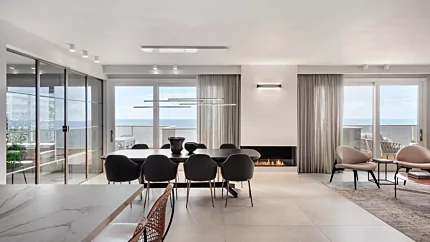
The built-in ethanol fireplace is the format for fire integrated into the room’s architecture. The Flex 50SS delivers a 1,270 mm [50 in] continuous dancing flame built directly into a wall, cabinetry, or joinery without a flue, chimney, or gas line. In the XL900 configuration, the entire viewing area is live flame with no media bed to interrupt it. Heat output is 15,000 BTU/h (4 kW), suitable for rooms up to 60 m² [646 ft²], with a minimum room volume of 110 m³.

For architects and interior designers, the Flex Series scales from 455 mm [18 in] to 4,015 mm [158 in] in viewing width, with zero-clearance installation throughout. Optional accessories, including the Black Glass Charcoal media or copper-finish Log Set, shift the aesthetic from contemporary-minimal to warm-organic depending on the design direction.

Placement and positioning: where to put your fireplace for maximum atmosphere

The most atmosphere-rich placement puts the flame at eye level from your primary seating position, within a room geometry that draws furniture inward rather than pushing it to the walls.

In a living room, a freestanding fireplace works best as a centrepiece: not against a wall, but positioned where seating can face it from multiple angles. Sofas and chairs angled toward the flame rather than a television create a conversation zone with a genuinely different social quality. For a built-in, the feature wall should sit opposite the primary seating so the flame is always in the primary sightline.

In a dining room, the T-Lite 3 centred on the table functions as both ambient light and warmth. Bedrooms and reading rooms suit an accent-scale piece in a corner; the AB3 burner’s 0.31 L/h fuel consumption means a 2.5 L fill runs a full evening at the lower setting without any attention.

On ventilation: AB3 burner models require a minimum room volume of 40 m³; the XL900 burner requires 110 m³. These are sizing guides as much as safety parameters. Matching the burner to the room is part of getting the atmosphere right.

Styling your space to amplify the warmth

The flame creates the foundation. The materials and objects surrounding it either amplify that warmth or dissipate it.

Natural materials respond to firelight differently than hard, reflective surfaces. A wool rug, a linen throw, a timber console, raw stone or a limewash-rendered wall: these absorb and scatter the flame’s glow, producing what might be called the texture of comfort. Dimming ambient lighting is the single most powerful styling move available. Low, warm-tone light lets the fire become the room’s primary light source rather than a competing element.

For designers, the product’s own materials do atmospheric work. The Pillar 3T’s Borosilicate glass cylinder fills a room with softened warm light rather than a direct point source. The Ghost’s reflective stainless steel panels multiply the flame’s visual presence well beyond its nominal 2 kW output. The Stix’s open sculptural geometry animates adjacent walls with warm, moving shadows in a way that an enclosed flame cannot. This points to a broader principle in interior lighting: how a material interacts with light often matters more to atmosphere than its heat rating.

The cozy advantage of zero-emission, clean-burning fire

Indoor ethanol fireplaces deliver the visual warmth and primal comfort of a real flame without the sensory compromises of wood fire, offering a genuinely eco-friendly heating alternative that loses nothing in atmosphere. No smoke drifts through the room. No soot accumulates on walls. No smell clings to throws and cushions overnight. The atmosphere is immersive and completely compatible with a considered interior.

The sustainability credentials are grounded in the science of bioethanol’s carbon cycle. Research by Harish Jeswani, Andrew Chilvers, and Adisa Azapagic at the University of Manchester found that sugarcane-derived bioethanol achieves approximately 60% lower lifecycle greenhouse gas emissions compared to petrol, meeting the EU Renewable Energy Directive threshold for renewable fuel. The mechanism: bioethanol combustion releases CO₂ recently absorbed from the atmosphere by the plant feedstock during growth, unlike fossil fuels that release carbon stored for millions of years. e-NRG bioethanol burns to produce water vapour and a small amount of CO₂, with no smoke, soot, or particulate matter, making it a zero-emission, sustainable heating source at the point of use.

EcoSmart Fire’s products are certified to UL 1370 (USA), EN 16647 BSI (EU/UK), and comply with Australia’s ACCC safety mandates. Because there is no chimney drawing air out of the building and no gas line tethering the installation to a fixed point, the fireplace goes wherever the atmosphere calls for it. That freedom of placement is itself a cozy-atmosphere benefit.

Creating cozy atmosphere in any room: practical scenarios

The right model depends on the room and the role the fire plays within it.

Living room: creating a hearth focal point

The Flex 50SS built-in fireplace anchors a living room feature wall with a 1,270 mm [50 in] viewing area and 15,000 BTU/h to warm a 60 m² [646 ft²] room. Where a wall installation is not preferred, the Orbit creates a 360-degree flame centrepiece that draws open-plan lounge furniture into a natural gathering arrangement around real flame.

Dining room: fire at table scale

The T-Lite 3 placed at the centre of a dining table brings real-flame warmth to a scale that suits the setting entirely. Its 8 to 11-hour burn time covers a long dinner without interruption, making it a practical replacement for candelabras with genuine flame presence for a full evening.

Bedroom and reading spaces: quiet warmth

The Pillar 3T in a bedroom corner adds quiet, ambient glow through its Borosilicate glass cylinder. Its oak, Carrara marble, or Nero Portoro marble base options mean it reads as a considered design object rather than a heating appliance, and its clean-burning flame leaves no odour or residue on textiles.

Open-plan and architectural spaces: defining zones with fire

For architects and interior designers specifying fire features across open-plan residential or commercial projects, the Flex Series built-in fireplaces offer see-through and double-sided configurations that define spatial zones without physical walls. Zero-clearance installation and a scale range from 455 mm [18 in] to 4,015 mm [158 in] give complete design freedom for both intimate residential applications and large-format commercial installations. Minimum room volume of 110 m³ applies for XL900 burner configurations.

Frequently asked questions

Can indoor ethanol fireplaces be used in any room of the house?

Yes, with appropriate ventilation. AB3 burner models require a minimum room volume of 40 m³; the XL900 burner in the Flex 50SS requires 110 m³. The ventless design means no flue or gas line is needed, so placement is flexible within those parameters. Most standard living rooms, bedrooms, and dining spaces meet the AB3 requirement comfortably.

How long does an ethanol fireplace burn on one fill?

EcoSmart Fire’s AB3 burner burns for 8 to 11 hours on a single 2.5 L fill of e-NRG bioethanol, at a maximum fuel consumption rate of 0.31 L/h. The Flex 50SS with the XL900 burner runs for 8 to 13 hours on a 9 L fill. Lower settings extend burn time further, giving the Pillar 3T or T-Lite 3 the range to cover a full evening comfortably.

Do ethanol fireplaces produce any smoke or smell?

No. e-NRG bioethanol burns cleanly, producing no smoke, soot, ash, or significant odour. The primary by-products of combustion are water vapour and a small amount of CO₂, comparable in scale to a candle flame. This is precisely what makes indoor ethanol fireplaces suited to sophisticated interior environments where air quality, surface finishes, and textile care all matter.

Are indoor ethanol fireplaces eco-friendly?

Yes. e-NRG bioethanol is produced from renewable plant-based feedstocks including sugarcane and corn. The CO₂ released during combustion is substantially offset by the CO₂ absorbed during feedstock growth, making it a genuinely low-carbon heating option compared to gas or wood. EcoSmart Fire’s products are independently certified to UL 1370 (USA), EN 16647 BSI (EU/UK), and comply with ACCC safety mandates (Australia).

Conclusion

The cozy atmosphere an indoor ethanol fireplace creates is the result of deliberate choices: the right model for the scale and mood of the room, thoughtful placement that draws the space inward, and materials that amplify the warmth the flame establishes. The flame is the foundation. Everything else is in service of it.

EcoSmart Fire’s range of freestanding and built-in designer fireplaces covers every scale and setting, from a portable tabletop accent to a 4-metre architectural feature wall. Explore the full collection to find the model that suits your space.

References