Loading image...

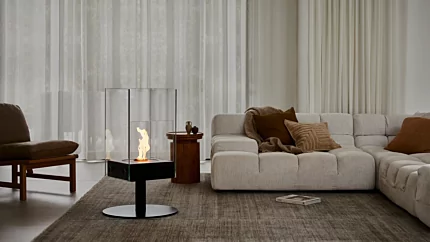
Orbit Designer Fireplace
A real flame used to be the one thing apartment living quietly gave up. No chimney, no gas line, no roof access for a flue, so the fireplace stayed on the wish list while the candles did the work. Bioethanol fireplaces for apartments change that equation. Because the fuel burns without smoke, soot or ash, there's no chimney to build and no utility to connect, which means the flame can finally live where the structure once said it couldn't. For the growing share of people who call an apartment home, that's not a small shift for apartment living. It's the same real flame, no longer dependent on architecture that the building never had.
Loading image...
Orbit Designer Fireplace
Yes, you can have a fireplace in an apartment. A bioethanol fireplace needs no chimney, no flue, no gas connection and no electrical wiring, so it can be placed in an apartment without structural modification, provided the room meets the minimum size requirement and basic clearances are respected.
That independence from the building is what makes the apartment proposition work. A wood fire needs a chimney the building was never designed for. A gas fire needs a supply line and venting that body corporates rarely approve. A no chimney fireplace running on bioethanol sidesteps both: liquid fuel is poured into a stainless steel burner, lit, and burns with a living flame that produces no smoke to extract. An electric unit removes the infrastructure problem too, but it replaces the flame with an effect: LEDs mimicking combustion. Bioethanol keeps the real thing, a living flame that produces actual warmth and moves the way fire always has.
Used in a well-ventilated room, the combustion is clean enough for indoor living, no smoke, soot, or ash to extract. A 2014 chamber study confirmed that adequate air exchange is the working condition: with it, ethanol fireplaces belong indoors, and without it, no fuel-burning appliance does. Tobias Schripp and colleagues, writing in Environmental Science & Technology, showed in that chamber study that ethanol fireplaces still release CO₂ and trace emissions into the room air, so a ventless fireplace for apartment use always belongs in a well-ventilated space, never a sealed one. With that condition met, the clean-burning behaviour of modern ethanol fireplaces does the rest: nothing to vent means nothing to build, and nothing to build means the flame goes where the room wants it, not where the structure allows it. The engineering behind that flame, from fuel regulation to flame stability, comes down to the burner itself rather than anything the building has to provide.
In a compact apartment, the fireplace's footprint matters as much as its flame. The range splits into three broad paths: freestanding pieces you place and move, wall-integrated fireplaces built around a zero-clearance insert, and built-in installations for owners already planning joinery or a renovation. Matching the form factor to your situation is the real decision, and the structural differences between the three paths are worth weighing carefully before committing.
Apartment situation | Suggested form factor | Example from the range | Why it works |
|---|---|---|---|
Renting, no modifications allowed | Compact freestanding | T-Lite 3, one of the lightest designer fireplaces at 7.44 kg | Certified, portable, and designed with the attention to detail that survives the move to three different apartments. |
Small living room, owner-occupied | Freestanding floor model | Pop or Pillar series | Real presence without consuming wall space or requiring trades |
Renovating with a feature wall planned | Zero-clearance insert | Flex 18SS, smallest in the Flex SS range | Builds into a cavity with no flue, gas or electrical connection |
Balcony or terrace | Compact fire pit or fire table | Stix or Sidecar 24 | Outdoor-rated, balcony-scale footprints with optional glass screens |
Loading image...
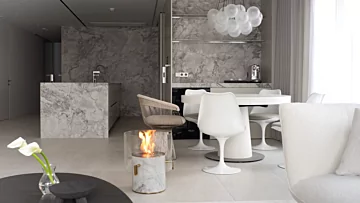
PIllar 3L Designer Fireplace
The compact end of the designer fireplaces range is built around the AB3 burner, and the footprints are genuinely small: models such as the T-Lite 3 start at roughly 340 × 340 mm [13.4 × 13.4 in], about the floor area of a side table. A freestanding bioethanol fireplace for apartments is genuinely compact by day and portable by evening: from the coffee table to the dining table to the balcony as the night shifts. The AB3 burner inside these models runs for 8 to 11 hours on a single 2.6 L fill and puts out 2 kW (5,800 BTU/h), enough gentle warmth for around 20 m² [215 ft²], which is to say, most apartment living rooms. Matching flame size to room size more precisely comes down to the burner's rated coverage and the room's volume, which the specifications for each model set out clearly.
Loading image...
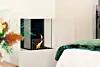

Flex 18BY Bay Fireplace
A glowing recess in the wall. No flue behind it, no trades required. That is the Flex insert in an apartment context. The Flex series of zero-clearance inserts builds the fireplace into a wall cavity or joinery unit, so the flame occupies no floor area at all. The Flex 18SS, the smallest insert in the Flex SS range, needs a cavity of roughly 579 mm wide, and because the insert requires no flue, no gas line and no electrical connection, “installation” amounts to cutting an opening and finishing the surround in a non-combustible material. The result reads like an architectural fireplace achieved without touching the building's services.
Loading image...

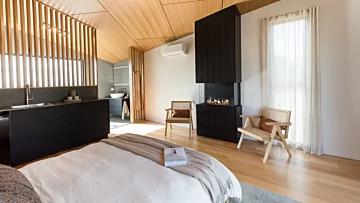 © Design & Build: EcoLiv / Photo:
@kimkeltiephotography
© Design & Build: EcoLiv / Photo:
@kimkeltiephotography Flex 32BY Bay Fireplace
For owners, the insert path opens up further. The Flex range comes in twelve opening sizes, so the fireplace can be scaled to the wall it lives in, from a compact study nook to a full feature wall in an open-plan living zone. Zero-clearance construction means the cavity needs no special structural treatment beyond the non-combustible surround, which keeps the renovation scope (and the conversation with the building manager) mercifully short.
Renters have historically been locked out of fireplaces entirely, and the design press has long advised the same workaround for everything else: choose portable, non-permanent pieces that deliver impact without touching the fabric of the building. A freestanding bioethanol fireplace is exactly that logic applied to fire. It's a bioethanol fireplace for renters in the most literal sense, no drilling, no flue, no alteration to the property, and when the lease ends it goes in the moving van.
Most landlords and property managers have never been asked about one, so frame the conversation around what the product doesn't require. Points worth raising:
It's a fireplace without flue for apartments: no chimney, venting, gas or electrical work, and no modification to the property
The product is independently certified, UL 1370 listed in North America and EN 16647 certified by BSI in Europe and the UK, and compliant with Australia's mandatory product safety standard
Fuel is stored in small quantities; below 20 litres indoors, no permit is required
The unit is fully removable and leaves no trace at the end of the tenancy
EcoSmart Fire has been engineering ventless bioethanol fireplaces for over two decades; those certifications reflect that development history, not a compliance checkbox.
Owners can take the same freestanding route or commit to the built-in insert path, which transforms the apartment rather than furnishing it. The practical difference is approval: a freestanding unit on a hard surface generally raises no building questions, while a renovation that opens a wall cavity will involve the body corporate or strata committee like any other internal works. Strata approval for a bioethanol fireplace varies between buildings and jurisdictions, so it's worth understanding your building's compliance and approval requirements before the committee meeting rather than after it.
A bioethanol fireplace is safe in an apartment when three conditions are met: the room is at least 40 m³ [1,413 ft³] in volume, the space is well ventilated, and the manufacturer's clearances and refuelling procedure are followed.
The 40 m³ minimum applies to all AB3-powered models, and most standard apartment living rooms clear it comfortably; a room of around 4 × 4 metres with a 2.5-metre ceiling already does. Ventilation matters more in apartments than in houses because high-density buildings tend to be tightly sealed. The CSIRO notes that buildings which are challenging to ventilate naturally, apartments among them, benefit from deliberate ventilation planning, and ASHRAE's residential standard sets a minimum air-change rate for dwellings precisely because fuel-burning appliances need fresh air. In practice: run the fireplace in a well-ventilated room, keep it away from cross-draughts that destabilise the flame, and crack a window during long burns. Clearances apply indoors as everywhere, a minimum of 600 mm side clearance from furniture and 2,000 mm overhead from anything moveable like curtains.
Fuel logistics scale neatly to apartment life. Storage below 20 litres indoors requires no permit; keep bottles sealed, away from the appliance and away from ignition sources. Choosing a quality fuel matters as much as storing it well, and there's real variation in fuel purity and formulation between suppliers. Refuelling follows a fixed sequence:
Switch the burner off using the Lighting Rod and the safe shut-off slider.
Wait 60 minutes for the burner to cool completely. The 60-minute window is the certified cool-down period; in practice, most users refuel the following day.
Fill through the dedicated filling point using the approved adapter or jerry can. Never pour from the bottle, and never pour over a flame.
Wipe any spill immediately and let it dry before relighting.
Note: an ethanol flame can be nearly invisible at certain angles, so always use the shut-off rather than trusting your eyes.
Inside the burner, a steel wool infill acts as a flame arrestor: it stabilises the flame, stops fuel sloshing in the reservoir and prevents flashback into the fuel body. It's a quiet piece of engineering, and it's a large part of why certified burners behave so differently from the open-bowl devices that prompted regulators to introduce mandatory standards in the first place.
Loading image...
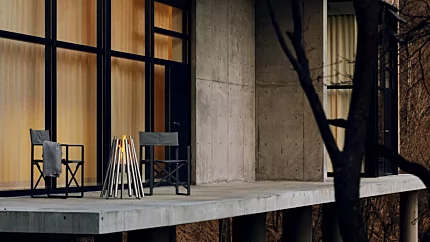
Stix Fire Pit
With the safety and ventilation side settled, the balcony becomes the next design question. The balcony is the apartment's second room, and a fire feature is what turns it from storage overflow into the place everyone gravitates after dinner. Architects have been making this move at urban scale for years; Dezeen has documented ethanol fire features anchoring everything from a San Francisco courtyard to a New York hotel rooftop, and the balcony version follows the same logic at domestic size.
Compact fire pits and fire tables suit balcony proportions. The Stix, one of the sculptural fire pits in the range, stands on a footprint barely larger than half a metre square, while the Sidecar 24 fire table was designed specifically for spaces where size is the deciding factor. Wind is the variable to plan for: balconies catch gusts that ground-level courtyards don't, so position the fire in a sheltered corner and use the glass fire screens available across the fire pit and fire table models to stabilise the flame. The standard clearances and the hard, stable, level surface requirement apply outdoors exactly as they do inside, and check your building's rules on balcony flames; most buildings in Australia and internationally permit certified ventless units on hard-surface balconies, and the answer is usually quicker to get than expected. With those boxes ticked, a balcony fire feature from the bioethanol fireplaces collection extends the apartment's usable hours and seasons in a way no heater quite matches.
A fire is the strongest focal point a room can have, and in a small apartment that's a spatial tool, not just an aesthetic one. Anchoring the living zone around a flame gives the eye a destination, which paradoxically makes a compact room read as composed rather than crowded. In open-plan apartments, designers increasingly use the fireplace as the zoning device itself; a London project featured in Dezeen ran a low wall with a bioethanol fireplace at its base to divide dining from living without closing either off.
A few directions that work at apartment scale:
A wall-integrated insert at eye level gives a small room vertical presence, drawing attention up rather than out
A low fire feature doubling as a coffee table centrepiece turns circulation space into the social centre
An insert built into joinery or a room-divider unit zones an open plan while the flame reads from both sides
Dark, matte surrounds make the flame the brightest object in the room, which flatters small-space palettes
The insert path also pairs naturally with the media wall trend, the flame and the screen sharing one architectural element, though combining fire and screen in a single wall has its own clearance and layout logic worth understanding before committing the joinery design.
For decades the fireplace was a privilege of detached housing, granted by chimneys and gas lines that apartments simply don't have. Bioethanol reverses the dependency: because the flame asks nothing of the building, the building can no longer say no. The same clean combustion that removes the flue requirement is what lets a fireplace sit on a rented coffee table, build into an owner's feature wall or anchor a sixth-floor balcony, and the same compact engineering that fits a burner into a 340 mm footprint is what makes the fire portable enough to follow you to the next address. Apartments are getting smaller and more numerous, and EcoSmart's compact burner engineering has been tracking that shift. The 340 mm footprint of the T-Lite 3 is not a coincidence. The instinct to gather around a flame hasn't shrunk with the floor plans. The fireplace didn't have to stay behind in the suburbs. It just had to stop needing a chimney.
Yes. Freestanding bioethanol fireplaces require no installation, no flue and no modification to the property, so they sit within what most tenancies allow for furniture. It's still good practice to let your landlord know, and leading with the fact that the unit is certified, ventless and fully removable usually resolves any hesitation quickly.
No. Bioethanol burns without smoke, soot or ash, so there is nothing to extract through a chimney. No flue, venting, gas line or electrical connection is required for any model in the range, which is precisely why the technology suits apartments.
For a freestanding unit, usually no formal approval is needed, though informing your landlord or building manager is good practice. For a built-in insert that involves renovation work, strata or body-corporate approval applies as it would for any internal alteration, and requirements vary between buildings and jurisdictions.
Yes, all bioethanol models in the range are suitable for outdoor use. Place the unit on a hard, stable, level surface, respect the standard clearances, position it away from strong wind exposure and use a glass fire screen where gusts are likely. Check your building's rules on balcony flames first, as policies differ.
Compact models built on the AB3 burner require a minimum room volume of 40 m³ [1,413 ft³], which a typical living room of about 4 × 4 metres with standard ceilings already meets. Beyond room volume, allow 600 mm of side clearance from furniture and 2,000 mm of overhead clearance from curtains or other moveable items.